You are currently browsing the category archive for the ‘Uncategorized’ category.
Christ’s humility is our armor, His love is our strength and His forgiveness disarms demons.

God loves us and wants us to be happy!
You are currently browsing the category archive for the ‘Uncategorized’ category.
Priscilla is a house mother here at the home for needy children in Oaxaca, Mexico, where I am currently enjoying God. She gave a nice devotional the other morning about trees, fruit and Christians. She mentioned the beautifully decorated mission Christmas tree nearby. I forget exactly what she said about the tree that related to our spiritual life, but it got me thinking.
I don’t know what the Christmas tree culture is like in the United States these days, since I have not been in the U.S. for Christmas for many years, but I imagine that it is similar to Mexico. Most people here have artificial trees. A few have real pine trees. My family has a real tree in our living room that looks and smells great. Christmas seems more Christmassy to me with a real tree. I think that the kind of tree, and the way a person decorates the tree for the holidays, indicates what kind of person they are. Where their priorities are and what is important to them, for good and for bad. But that is beside the point. Forgive me. I wander as I wonder.
What I am wondering about is how do different Christmas trees look like different types of Christians, or represent different spiritual outlooks. For instance, here in Oaxaca Mexico I see a great variety of fake trees. Some look really fake, and some look relatively lifelike. There are some that are all white, perhaps to give the idea of a snow covered tree. We don’t get snow here where I live, but I wonder, what kind of a Christian would a fake white tree indicate.
Then there are the blue trees, the orange trees and the purple trees. And the multicolored trees. I don’t know if they have these colors of artificial trees in the U.S., but I see them for sale at places that sell fake trees here. What kind of Christian do you imagine as one of these trees? You see a tree with some red branches, some green branches, and some indigo colored branches, and you think to yourself, “Self, that tree reminds me of _________.
A few people, although they seem to be dwindling in number, prefer real trees. Every tree is different. Most smell great, and they all have shedding pine needles and they have to be thrown away after  Christmas. What kind of Christian does that seem to you?
Living trees are also popular among some folks. They are a good idea to me and I have often thought that I would like to have one some year, but they are usually pretty expensive. The upside is that you can plant it in your yard when Christmas is over, and can enjoy it all year round. What Christian personality comes to mind when you think of this kind of tree?
It’s not really a Christmas tree until it is decorated. Every person and every family has their own preferences when it comes to decorating old tannenbaum. Some trees look like Martha Stewart was called in to arrange the lights and bulbs. Others remind me of a “Charlie Brown” tree with a single strand of lights and a couple cracked and faded ornaments dangling precariously from a few thin limbs. Most Christmas trees fall somewhere in between these two extremes.
The Schwab tree has flashing orange and green lights with some store bought ornaments, some that were given to us, and most that were hand made by Sally and Kelly, or by friends. If I was that kind of Christmas tree Christian, and who is to say I’m not, what would my spiritual personality be?
The cool thing about Christianity is that God has chosen very diverse people to be His followers. There are about as many different kinds of Christians as there are, well, as there are decorated Christmas trees. This Christmas, let’s not forget to thank God for all the different kinds of Christians in the world. Some may seem a bit strange. Some do things differently than you or I would do them. Some are really theological and others very socially minded. Some are active in the church, and others are active in the community. Some are introspective and others are people persons. All think or believe a little differently (or a lot) about almost every issue that you can imagine. All are beautiful in God’s sight. All bear His image. And all of us together make for an incredible looking Christmas tree. God bless us everyone.
***** ***** ***** *****
The Schwab family wishes each and everyone one of you a very Merry Christmas and the Happiest of New Years!!!

Anita, Kelly, Sally, Me
In Stephen Kings book Lisey’s Story, he writes about Bad Gunky. He uses this phrase to refer to an evil 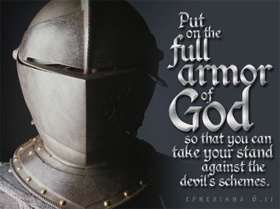 presencee that his main characters are sometimes up against. I think of this phrase when I think of the Christian’s spiritual enemies. Luther talks about the World, our Fleshly desires, and the Devil. Paul warns the church in Ephesians that our battle is against the Devils schemes, the Authorities, Principalities, Powers of Darkness and Spiritual Forces in the heavenly realms. Bad Gunky all!
Paul also tells believers in Christ how to defeat these enemies of our soul. In Ephesians 6:10, he says to be strong in the Lord and in His mighty power. That sounds great, but how do we do it? Paul explains that we need to put on spiritual armor. Or, as Stephen King says in the same book, “Strap it on!”
Of all the pieces of spiritual armor that we need to strap on, I think the most important piece is “the sword of the Spirit, the Word of God”. It’s significant that Paul mentions both Spirit and Word. There are theologians the world over that have a tremendous grasp of the Bible, but don’t have the Spirit, and are spiritually defeated. There are many Christians who claim to be filled with the Spirit, but are ignorant of much of God’s Word. They also suffer defeats regularly in the spiritual
realm. To be victorious we must have the sword of the Spirit, which is the Word of God. Spirit and Word. All the other pieces of armor are ultimately based on these two things.
With that said I will list the other pieces of spiritual armor, and rather than going into a long description of each piece, I will simply include a few relevant scriptures.
BELT OF TRUTH
Jesus said, “I am the way, the truth and the life. No on can come to the Father except through me.” John 14:6
You shall know the truth, and the truth will make you free. John 8:32
BREASTPLATE OF RIGHTEOUSNESS
But now, the righteousness of God has been made known apart from the law. This righteousness is given through faith in Jesus Christ to all who believe. Romans 3:21,,22
SHIELD OF FAITH
For it is by Grace you have been saved through faith – it is not of yourselves – it is a gift of God. Ephesians 2:8
If you have the faith of a mustard seed, you can say to this mountain, “be removed from here and be cast into the deepest sea” ans it will be done. Matthew 17:20
GOSPEL OF PEACE
I am not ashamed of the Gospel of Christ, for it is the power of God for salvation to all who believe. Romans 1:16
My peace I give to you. Not the kind that the world gives, I give to you. John 14:27
HELMET OF SALVATION
Confess with your mouth that Jesus is Lord and believe in your heart that God raised him from the dead, you will be saved. Romans 10:9
A cursory reading of these verses makes it plain that they are all connected in a radical way. You can’t have one without the others. A soldier back in the day could walk into his local armor shop and pick and choose which piece he wanted. He could a quote on one or two pieces or buy the whole shebang. As Christians, we get the whole outfit when we trust Jesus for our salvation.
I think the reason that Paul lists them all as separate entities is that the act of putting on each piece, should be a daily act of meditation each morning before we go out to face the day, to face the enemy. God gives us each piece free of charge, and the mental act of strapping on each piece each day, each morning should give us cause for rejoicing in God and result in an attitude of strength that enables us to overcome the worries, frustrations, anxieties and anger that Satan and his minions will sling at us. With the spiritual armor of God we will be “strong in th Lord and in His mighty power.” We will go victorious into the day, full of joy knowing that God loves us and wants us to be happy.
Schwabbynitions
Faith – believing that God loves you and wants you to be happy.
Righteousness – enjoying living in right relationship with God.
Peace – not just the absence of conflict, but wholeness and contentment in every aspect of life.
Gospel – the Good News that God loves us and wants us to be happy, and has revealed the way to inner joy through His Word.
Salvation – being saved eternally from the power of sin and the wrath of God. Being saved daily from the time of trial and the Evil One.
Truth – reality as seen through the eyes of God and revealed to us through scripture.
***** ***** ***** *****
Christ’s humility is our armor, His love is our strength and His forgiveness disarms demons.
In my last post I began to write about Christian Unity, especially as it relates to Paul’s letter to the  Ephesians in chapter four. In that chapter I found ten items that are important to unity in the Community of Faith. I wrote about five critical elements last time, and will conclude with five more this time. The five points of Christian Unity in my last post were:
1. Walk worthy of the calling you have received
2. Be completely humble
3. Put up with each other
4. Make every effort to keep the bond of unity
5. Love one another
One Lord, One Faith, One Baptism
6. Paul goes on to mention One Lord, One Faith, and One Baptism. To believe in and to have only one Lord was an extremely important idea in the time that Paul lived and wrote. There was a major player who lived at this time who also demanded allegiance as the one Lord, and that was the Emperor. It would have made life easier for the early Christians if they could have two Lords in their lives; Jesus and Caesar. But Paul assured the believers in the early church that they must acknowledge and worship only Christ. Many early followers of Christ were forced to choose one or the other, and for many they confessed Jesus as Lord in their dying breath.
In the same phrase we hear Paul mentioning One Faith and One Baptism. For me, true Faith can be boiled down to the belief that God loves us and wants us to be happy. When people come to that belief that they can only be truly happy by trusting their lives to God and what was accomplished by Christ’s work on the cross, then they naturally want to proclaim that fact to the world by experiencing the One Baptism, in the name of the Father, Son and Holy Spirit.
One God and Father of All
7. Then Paul writes about “One God and Father of all”. To talk about God as Father was somewhat revolutionary for the Jews and the gentiles. The whole Old Testament only refers to God as Father five times. The Jews didn’t really relate to God as Father. Jesus turned their heads and got their attention when he began to refer frequently to God as Father; not just his father, but as Father to all followers. Paul continues with this glorious concept in most of his letters, and marks this idea as very important to Christian Unity. The commUnity of Faith must not only believe in God in general, and look to Christ as the head of the body, but also needs to see God as the Father of the Christian family. The Father who adopts, who loves, and who gives good gifts to his children because he loves them and wants them to be happy.
Identify and Use Spiritual Gifts
8. Next Paul tells the church that God gave gifts to the disciples of Christ to build up the church and bring it to a greater unity. The gifts God gave were, and still are, the gifts of apostles, prophets, evangelists, preachers and teachers. Unity doesn’t happen in a vacuum. Unity doesn’t happen without effort. To grow unity in the body of Christ we need to have everyone to be first aware of their gift, then educated in the use of their gift, and finally to use their gift. It’s like building a house. First the carpenter has to be aware of the tools at his disposal. The circular saw, nail gun and drill. Then he has to know how to use the tools, and have a power source to run the tools. Finally he has to actually pick up the tools and begin cutting boards, nailing then together and drilling holes in appropriate places.
Many Christians have spiritual gifts, but they are not aware of what they are. A wise church or Christian organization will have classes to educate people on the spiritual gifts and determine who has what gifts. For example, at the home for needy children in Oaxaca Mexico, where I am helping out, we are going to have a series of classes, led by our administrator, Jill Adams, to help the staff identify their gifts, learn how to use them and then put them to work to make our local commUnity of Faith stronger and more effective in ministering to the “least of these” in Oaxaca.
Speak the Truth in Love
9. In verse 15 of chapter four, Paul writes about “speaking the truth in love”. The number one thing that causes disUnity in the church and division in the body of Christ is the bad things people say. Negative things people speak. Gossip, slander, words of anger, tongue wagging lies, or speaking the truth in hate. Paul echoes this sentiment later in verse 29, when he admonishes believers, “Don’t let ANY UNwholesome talk come out of your mouths, but ONLY that which builds up“. Christians should never berate one another, complain about others or grumble about fellow followers of Christ. When they speak incorrectly they are tearing down the body and not building unity.
10. “The whole body of Christ builds itself up in love, when every part does its work.” Paul wants all believers everywhere to know that this Unity thing is work! Everyone and every part needs to Work at unity. It doesn’t happen naturally, in fact most of these ten items go against our natural grain as sin bent human beings. The World, the Flesh, and especially the Devil, don’t especially like Christian unity. Paul goes on to talk about the great spiritual struggles we face everyday, and the need to be strong in the Lord and in his mighty power, and to put on the spiritual armor to defeat the Enemies and to grow Unity. This isn’t easy. It takes dedication, commitment and intention to accomplish. In short, it’s Work!
Let all Christians everywhere strive for unity. It’s what God wants because he loves us and wants us to be happy. Us as individuals and as a commUnity of faith.
***** ***** ***** *****

Unity is important whenever any group of people get together and want to accomplish something. Take the United states of America for instance. Over the head of the eagle on the one dollar bill and the quarter are the words e pluribus Unum. It is Latin for “out of many, one”. When the founding fathers got together to decide on a seal to represent their new country, they must have looked around and noticed that there were people from many different countries, religious beliefs and political philosophies, and they realized that if this fledgling nation was going to make something of itself, they would have to somehow become one. Unity means “one” in Latin. They founded “one nation under God” and called it the United States of America.
Unity is not only important for making strong nations or businesses, but is also important in making a strong Church Universal, and strong communities of Faith.
I have been studying Ephesians lately, and Paul writes a lot about unity, especially in chapters three and four. In chapter three he focuses on the unity of the Jews and gentiles that was accomplished by Christ’s work on the cross. In chapter four he fleshes out what it means for the church at large and for individual communities of Faith to live in unity. I found ten important keys to unity in chapter four. In this first part of my study I will list five, and in the second part I will list five more.
Walk Worthy
1. In order for there to be Christian unity, each individual must walk worthy of the calling that they have received. That calling is, to quote the Westminster Shorter Catechism, “to glorify God and enjoy Him forever.” To accomplish that, we must strive to love God with all of our heart, mind, soul, and strength; and to love our neighbors as ourselves.
Be Humble
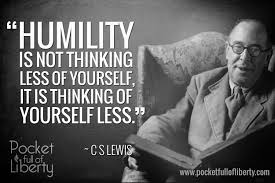
2. Paul also writes that we are to completely humble (NIV) . What does it mean to be completely humble? I think that there are three ways to look at that. One is to take to heart what Paul wrote elsewhere – “esteem others better than yourself”(Philippians 2). We naturally want to think that we are better than everyone else and find fault with others in order to make ourselves seem better than we really are. That is not being completely humble. Two, Paul also tells Timothy that he, Paul, is the worst of sinners. To be completely humble we must see ourselves as the worst of sinners, for whom Christ died. The third, and perhaps best way to be completely humble is to do what C.S. Lewis says, and that is to think of ourselves less. Put the focus on God and others.
Put Up With Each Other
3. Paul next admonishes the Christians to be patient, bearing with one another. These two items are so closely related to each other that they can be taken as one item; one coin (or tortilla as my wife likes to say) with two sides. A translation that I prefer for the idea of “bearing with one another” is “to put up with one another.” We all know brothers or sisters in Christ who do things that really bother us. Things they do that we don’t agree with, yet these things that they do (or don’t do) are not specifically mentioned in scripture. So what should we do about it? Put up with it!
This is especially wise advise for those of us who live in community, like those of us who live and work together at FFHM’ s Home For Needy Children in Mexico. The staff members at the children’s homes typically come from the U.S., Canada and Mexico. We have different cultures, upbringing and spiritual traditions. We all do things differently from one another. Our initial reaction upon encountering others who “do it differently” is to think that they do it wrong and that I do it right. That is exactly what Satan wants us to think in order to foster dissension and division. To brake up unity and weaken the Body of Christ. Paul tells us to put up with the people who do it differently. To do that we need to be patient. With patience, over time,one of three things will happen-1. God will change the other person, 2. God will change me, 3. God will use our differences, our diversity, to make the community of faith stronger than it would be without the differences.
Make Every Effort
4. Paul goes on to tell the believers to “make every effort to keep the bond of unity.” He is telling us that unity is work! Unity must be intentional. Unity doesn’t happen naturally. In fact is usually goes against our sin tainted nature’s. Almost every action we take or word we speak either strengthens that bond of unity or weakens it. Everyday we should wake up and ask God what we can do to build up Christian unity, and ask him to reveal attitudes we have that can diminish that unity, and then act on what the Holy Spirit reveals to our hearts. That is making every effort.
Love
5. Next Paul talks about One Body, One Spirit, to which you were called in One Hope. All believers are one body, the body of Christ. It is the one Spirit that makes the body alive, that gives the body strength and that guides the body. We were called by the Father to live in and look forward to one hope. We have the many in this phrase of Paul’s; the body of Christ, the Spirit, and the Father who called us. It’s the trinity, the ultimate example of true unity, of true and perfect unity to which we were called. As I mentioned earlier we are ultimately called to glorify God and to enjoy Him forever. How do we glorify Him and enjoy Him? Remember the two greatest commandments, Love God with all our being and love our neighbors as ourselves. In many places where Paul talks about unity, he includes the Word love. There can be no unity without love.
When most people hear the word “love”, they think about emotion. That is fine and dandy if we are talking about “Eros” or romantic love, or if the topic under consideration is “phileo ” or brotherly love. But talking about the great commandments, we are talking about “agape” love, and the foundation for that kind of love is not emotion but devotion. Devotion to God and doing His will. Devotion to one another despite our differences, perspectives on life, and world views. Agape love puts the “other person” first and results in strong chains that build up the body of Christ, glorifies the Spirit, and produces an enduring hope.
To be continued…
***** ***** ***** *****
 I have been reading Ephesians lately and have been taken with the idea of the heavenly realms. I have read Ephesians many times before and never noticed how important a place that the idea, the reality, of the heavenly realms were to Paul, and how important they should be to our thoughts and actions.
The Apostle uses the phrase “heavenly realms” five times in this short letter. In the first chapter he uses it twice. In verse three he tells believers that they are blessed in the heavenly realms. Most of us think mainly of the blessings we receive, or want to receive in the earthly realms. Paul tells followers of Christ that we are blessed in the heavenly realms, and those blessings don’t just trickle down to us here on earth, but they cascade down upon us from on high, from the heavenly realms.
And why are we so fortunate to receive these blessings? Paul goes on to say that Christ was raised from the dead and is seated in power at the right hand of the Father. That same power that placed Jesus on the throne is the power that saves us, forgives us, redeems us and puts us in right relationship with the Father. What incredible blessings those are!
But wait, there’s more! Paul writes in chapter two, the famous “Grace” chapter, that even though we were dead in our trespasses and sins, we who have been blessed with His grace and mercy, have also been seated in the heavenly realms. This signifies that we also have been given power, the power of the throne so to speak. We are not literally in heaven, just as an earthly king is not literally on the throne all the time, yet he continually has the power of the throne and the crown. God has endowed us with power from on high to overcome sin and the enemy, which Paul refers to in chapter three and chapter six.
In chapter three Paul begins to write about the gentiles and how through the work of Christ they have been joined with the Jews as God’s chosen people, and this combined group of Jews and gentiles are now called the church, the called out people. They are called out of the system of the world dominated by the “ruler of the air” (chapter two). Paul tells the Ephesians that the church is to show the wisdom of God to the rulers and authorities in the heavenly realms. Who are these “rulers and authorities”? And what does it mean for the church to show them the wisdom of God? When we have questions about the meaning of a Bible passage, it is best to let scripture interpret scripture, so let’s take a look at the final “heavenly realm” passage in Ephesians.
In chapter six we have the famous passage about our spiritual armor. What do we need spiritual armor for? To fight spiritual battles with spiritual enemies. Paul tells us that the enemies are not flesh and blood, but rulers, authorities, dark powers and spiritual forces in the heavenly realms. So we learn that everything is not beauty and spice and everything nice in the heavenly realms. We have enemies to fight, battles to win in the heavenly realms. We must all put on the armor of God every morning. Each individual joins the army, the church, to defeat the forces of evil.
I help out in a home for needy children in Oaxaca, Mexico. Every child that comes into the home is a child saved from the devil, who wants to kill, steal and destroy these precious little ones. When they come to know Jesus as their Savior, and come to the realization that God loves them and wants them to be happy, it gives Satan a black eye. It is a setback to his evil hordes. Each child that is seated in the heavenly realms deals a blow to the plans of the rulers and authorities in high places, showing the wisdom and power of God.
***** ***** ***** *****

What is this thing, this action, that in and of itself is not a sin, but when most people attempt it, they usually end up sinning? What is it that people do millions of times a day, and usually do it wrong?
The answer is talking. Of the multitude of sins that are chronicled in the Bible, none is more common or more destructive than the sin of words and talking. The apostle James speaks much of this in all five chapters of his little book. Most forcefully in chapter three, where he calls the tongue a wild fire, a poison, something straight from the pit of hell. Our words can poison relationships, burn out a community of faith and destroy years of good work. Who can tame the tongue?
And even if a person never gossips, slanders or badmouths another person, their words can still be sin! Paul, in Ephesians four, tells the church that every word uttered should only be for the uplifting, edification and strengthening of the body of Christ. If not, it’s a sin. The last two letters Paul wrote in his life that we have in the Holy Scriptures are written to Timothy. Paul knew his time on earth was short, and his last instructions were of utmost importance, so he emphasized the most important truths to his young charge. In both letters he told Timothy to “avoid godless chatter”. What is “godless chatter”? It is any conversation with another person that does not in some way include or point to God. If we talk a lot about the weather or sports, or other people or events, and that discussion does not have its basis in God, then we are skating on thin ice. We are probably sinning.
Back to the book of James. He says that anyone who controls his tongue is perfect. We all want to be perfect and mature before God and man, so we need to control our tongues. The best way to control our tongues and thus be perfect is to not talk at all. Never utter a word. Most people are probably aghast at the thought of not being able to voice their opinion, tell the world what they think, or stand up for themselves with their words. They are probably sinning. We have all heard of monks who take a vow of silence; who don’t talk. Perhaps we think them crazy. We should think them very wise. Perfect. They have tamed the tongue.
Of course the Bible talks about good words. Happy, encouraging words can be like medicine to a broken heart. Doctors don’t hand out any type of medicine to their patients in a helter skelter kind of way. First they diagnose the problem and then give out the exact prescription that is needed to bring healing. We should be like that with our words. Paul writes in Romans ten that people need to hear the words of the gospel to be saved. We need to offer life saving gospel words to lost people in a sick world.
In order to speak helpful words and not sin words, we need to put a filter over our mouths and carefully, thoughtfully, prayerfully think before we speak. All of our cars have air filters, oil filters and gas filters to keep harmful particles from going in the engine and causing destruction. We need the same kind of mental and spiritual filters between our brain and our mouth to keep harmful words from going out and causing harm. The Psalmist writes “Set a guard, O LORD, over my mouth; keep watch over the door of my lips! ” (141:3)
If we are careful to maintain these filters or guards or doors between our brains and our mouths, we will speak words of life and not death, words of health and not poison, words of hope and not destruction, words of righteousness and not sin. If we watch our words we will glorify God and enjoy him all the more!
Words about words from Proverbs –
12:18 There is one whose rash words are like sword thrusts, but the tongue of the wise brings healing.
12:19 Truthful lips endure forever, but a lying tongue is but for a moment.
15:2 The tongue of the wise commends knowledge, but the mouths of fools pour out folly.
15:4 A gentle tongue is a tree of life, but perverseness in it breaks the spirit.
17:4 An evildoer listens to wicked lips, and a liar gives ear to a mischievous tongue.
18:21 Death and life are in the power of the tongue, and those who love it will eat its fruits.
21:23 Whoever keeps his mouth and his tongue keeps himself out of trouble.
25:23 The north wind brings forth rain, and a backbiting tongue, angry looks.
26:28 A lying tongue hates its victims, and a flattering mouth works ruin.
28:23 Whoever rebukes a man will afterward find more favor than he who flatters with his tongue.
31:26 A virtuous woman opens her mouth with wisdom, and the teaching of kindness is on her tongue.
***** ***** ***** *****
In our chatty world, in which the word has lost its power to communicate, silence helps us to keep our mind and heart anchored in the future world and allows us to speak from there a creative and re-creative word to the present world.
Henri Nouwen – The Way of the Heart
I’ve been reading Ephesians lately. It’s a pleasant change from Ezekiel. Ezekiel was full of sin, disobedience, judgment  and the wrath of God. It contained strange visions and bizarre symbolic actions. Some things were hard to understand and confusing. When I read scripture in the morning I try to find a phrase or encouraging word that I can meditate on throughout the day. Those words and phrases were few and far between in Ezekiel. Thank God for Ephesians!
With Paul’s letter to the Ephesians, I find words or phrases that I can hang my spiritual hat on in almost every verse; certainly in each paragraph. After a couple weeks of basking in the glory of chapter one, I came to the second chapter. It starts out with the words, “As for you, you were dead”.
It’s unfortunate, in some ways, that there are chapters in the Bible. It was not originally written with chapters. When Paul wrote his letter to the Ephesians, he did not separate his letter into six different chapters. It was a unified whole. But when we read it, we see chapter division. Each chapter is intricately connected with the chapter that came before and the chapter that follows. Many times we miss that connection, because we have a tendency to read the Word of God one chapter at a time; one chapter a day, and we miss important connections. That initially happened to me upon reading chapter two. Ephesians two is a well loved chapter to most Christians, being rich with images, words and phrases about salvation, grace and mercy. I was anxious to reread those beloved verses and practically skipped the first, rather unflattering words of Ephesians two.
I caught myself and went back to the opening words of the chapter. “As for you, you were dead …” I thought about the first three words, “As for you” . I recognized those as transition words. Now he is talking about “you”. You Ephesians, or more generally, you believers, or you Christians. Well what was Paul talking about before, at the end of chapter one? What was he comparing us to? I went back and reread the last paragraph of one. Paul was comparing us to Christ.
We were dead. What was Christ? Christ was raised from the dead. Christ was seated at the right hand of God, seated in the heavenly realms, far above all rule and authority, power and dominion, and every name that is invoked. All things were placed under his feet, and appointed as head of the church. He fills everything in every way.
And who were we? What were we? We were dead. What an incredible contrast the apostle Paul presents between us and Christ!
My meditation phrase for that day was “and you were dead.” Or more personally, I reminded myself that “I was dead!” Maybe you want to try out that phrase within your day. Remind yourself over and over that you were dead. You were a spiritual corpse, without hope of true life, abundant life, eternal life. Then go and read the rest of the first paragraph of Ephesians two. See how great is the impact, how meaningful and significant those following words of Paul become – But God made you alive!
***** ***** ***** *****
While we remain in Adam, we are entirely devoid of life; and that regeneration is a new life of the soul, by which it rises from the dead. John Calvin
It was getting hot and uncomfortable in Judea. Not hot as in the physical climate, but the social and spiritual climate  was becoming unbearable. Jesus told his followers that they were heading north. The Master wanted to get back to his old stomping grounds -Galilee. Not that he couldn’t take the heat, but Judah was fast becoming a place where he couldn’t help people like he really wanted. The religious leaders were turning his ministry into a side show, and at this point in his early ministry Jesus wanted no part of that, although it would be hard to avoid no matter where he went, because no matter where he went he healed the sick, the blind received sight, the cripples walked and demons were cast out. Everyone wanted a piece of that action, and the Master was happy to provide it; happy to make people whole; happy to rejoice with them, although the real wholeness that he came to bring was much more than physical healings. Deep down the masses were suffering from mental, emotional and spiritual sicknesses. He especially wanted to bring healing and wholeness to them. That was another reason he wanted to head north. He had a divine appointment with a sick woman at a well.
It was not just any woman, it was a Samaritan woman, which meant they must go into the heart of Samaria. It would be a hard pill for his Jewish disciples to swallow. They didn’t like Samaritans very much. It was hard for them to get along. Hundreds of years ago the Samaritans intermarriage with Assyrians turned them into half breeds and that was something most Jews just couldn’t let go of. They had so much to learn. Normally when they traveled north to Galilee they would skirt around Samaria, even though it made the journey longer. This time the trip would take them through the hated peoples terrain. So much to learn.
Jesus was smiling as he and his band of brothers crossed the boarder into Samaria. His followers – not so much. It was midday when they stopped for a rest at a well outside the little town of Sychar. The disciples wanted to push into town and try and find something for lunch. Jesus told them to go on without him. “Stinkin’ Samaritans! Probably spit in our pita bread” one disciple whispered under his breath as they headed into town.
They disappeared over a hill at about the same time that a woman from town topped the hill and made her way to the well. She was all alone.
She looked down towards the well and was dismayed to see a man sitting there. While most of the town’s folk went for water in the cool of the morning or evening, she preferred to go at midday. Even though it was hotter, it was also quiet. Peaceful. Her noontime trips for water gave her a chance to be alone with her thoughts, away from the stares of men and disapproving frowns of women. Oh well, she would just have to make the best of a bad situation. Something she was used too. At least this man wasn’t from town; he was clearly a stranger. Getting closer she saw he was really a stranger. She could tell by his clothes and facial characteristics that he was a Jew. “No way!” She thought. Jews never come around here.
Lowering her water jar into the well, she was surprised that this strange man spoke to her. This Jew.
“Will you give me a drink?” He asked. On the surface it seemed a simple question. He was thirsty and she had water. Beneath the surface it was extremely bizarre. Most Samaritans knew that Jewish men thanked God everyday that they weren’t born gentiles, women, or dogs, and while she wasn’t a dog, she was clearly a woman, and probably considered worse than a gentile. If he drank from her water jar, she knew he would be considered “Unclean” in polite Jewish circles, whatever “unclean” meant.
When Jesus asked the woman for a drink, he seemed to have twinkle in his eye, as if he were playing some kind of game where he had made the opening move, and now it was the woman’s turn. She decided to play along.
“You are a Jew and I am a Samaritan. How can you ask me for a drink?” Two can play at this game, she thought.
She was taken aback at his reply. “If you knew the gift of God and who it is asking you for water, you would ask him and he would give you living water.”
She had no idea what He was talking about, but she like the sound of “living water”. She replied, “You have nothing to draw water with, and the well is very deep; how are you going to get this living water?”
Jesus looked into her eyes and explained to her that whoever drinks water from this well will be thirsty again. But whoever drinks the water I give will never thirst again. In fact the living water I give will well up within and streams of water will gush out leading to eternal life.
Jesus has said a mouthful, overwhelming the woman’s ability to take it all in. But the phrase, “never thirst again” caught her attention.
“Give me this water to drink so that I won’t have to come here everyday to draw water.” She replied.
Jesus decided to go deeper to help her understand what He was really talking about. “Go get your husband and come back to me.”
Husband? Husband! What did having a husband have to do with living water. She thought of the five husbands she had had. All the dreams and hopes that came with each wedding, and all the heartache and pain that came with the end of each marriage. She had finally given up hope of finding any fulfillment in the institution and settled for just living with a man. At least she would have a roof over her head and food in her belly.
She thought of the strange man’s request again and something began to rise in her. A strange mix of self pity and anger. She didn’t know what to say. She was getting uncomfortable with this man and his words. Hoping to brush him off she simply told him she had no husband and turned back to her water jar.
His next words struck her hard. “You’re right. You have no husband. You have had five husbands, and the man you are living with now is not your husband. You have certainly told the truth.”
This man was really starting to get on her nerves. She felt shocked and ashamed. How could he possibly know about her past. What business was it of his? She certainly was not going to discuss it with Him. She hastily changed the subject and decided to discuss religion. That should definitely get this Jewish guy going in a different direction.
“Wow, you must be some kind of a prophet or something. I know you Jews think Jerusalem is the place to worship, but our ancestors worship at this mountain”, she said pointing off to Mount Gerizim.”
Jesus spoke gently to her saying, “Jerusalem is the correct place to worship. Salvation comes from the Jews. But that’s beside the point. A time is coming, and the truth is, the time is now, that true worshipers will worship the Father in spirit and in truth. God is spirit, and his people must worship him in spirit and in truth.”
Again, the woman was somewhat overwhelmed by the the man’s words. They sounded nice, and at least he didn’t bring up her husbands again. Both the Samaritans and the Jews were looking forward to a time when the Messiah would come and make things right in the world. That was always comforting to her. She often imagined herself talking with the Messiah and having him resolve all the religious struggles she had within; heal the spiritual sickness she often felt. Not to mention all the personal issues she was dealing with. She blurted out, “some day the Messiah will come and answer all our questions.
Jesus answered her saying, “I am the Messiah.”
Wouldn’t you love to know what became of the sick woman at the well? All we know is that after Jesus proclaimed he was the Messiah, his disciples came over the hill with some food and the woman hurried off. She forgot her water jar and went into town to tell the people of a man at the well who told her all about her life. She also asked, “Could this be the Messiah?”
Did she believe he was the Messiah? Did she she drink deeply of the “living water”? Did she go on to live a life peace and joy? Of fulfillment and wholeness? Was she able to bury the demons of her past? Or did she dismiss the stranger at the well as a crazy person who was just yanking her chain? We don’t know. I think that’s the way John wanted to end this saga of the woman at the well. John also mentioned in his gospel account in chapter four, that many Samaritans came out to give Jesus words a listen, and that they asked this JEW to stay with them a few days, and that many believed.
Why did John write this story that the other gospel writers did not include in their books? Why did John write any of the stories that he wrote? He says in chapter 20 that these things were written that you may believe that Jesus is the Messiah, the son of God, and that by believing you might have life through his name. What does it mean to drink the living water that Jesus offers? It means to believe! How about you? Do you believe?
***** ***** ***** *****
From time immemorial men have quenched their thirst with water without knowing anything about its chemical constituents. In like manner we do not need to be instructed in all the mysteries of doctrine, but we do need to receive the Living Water which Jesus Christ will give us and which alone can satisfy our souls.
Our family went to a wedding on Saturday. Robin Williams committed suicide on Monday. I’m not saying there was a connection, but there are some interesting contrasts.
The young couple tied the knot on a beach in Puerto Escondido. It was a beautiful wedding. It was a solemn yet casual affair. The young couple are Christians, children of missionaries who are working to bring the Bible to ethnic groups in Oaxaca, Mexico, who have never heard the Word of God in their native language. We sang Christian songs in Spanish and English. The grooms father is German, and he prayed for the couple in German. The bride and her family are from Canada. It was a great mix of people from different cultures who spoke different languages and lived different cultures, but all had one thing in common-a love for God and the work of Christ on the cross.
The young couple, Timmy Schwab (no relation to me, although, after the wedding there was a special activity for the Schwab family that I tried to horn in on, without success) and Johanna Quezada, beamed with joy through the whole ceremony, Timmy smiling delightfully at his bride to be throughout the whole thing. After kissing his new wife he picked her up and ran down the sandy isle between the attendees.
So what does this happy occasion have to do with the self inflicted death of Robin Williams? The news reports of his death said he had suffered from depression and drug addiction for many years, and in his last days the depression had grown severe.
What does the general public think will make them happy? Wealth, power, fame, adulation, nice houses and cars. For some you can throw in drugs. Robin Williams had it all, and was so depressed he killed himself.
Timmy and Johanna barely have two pesos to rub together. I don’t think they have a house and they may have an old car. They definitely don’t have fame or power. So why are they so happy and Robin Williams so depressed? Because they have the love of Jesus, love of Jesus, down in their hearts. The have confidence and certainty that the creator of the universe loves them and brought them together to live a life of enjoying God together as they cooperate with Him in bringing His kingdom and doing His will on earth as it is in heaven.
Robin Williams never had the eyes of his heart opened by the holy Spirit, and lost the battle with the world, the flesh and the Devil. He seemed to have it all, and had nothing. Timmy and Johanna appear to have next to nothing with regards to worldly possessions, but they are living large in the riches of God’s grace and mercy and in their love for each other!
***** ***** ***** *****

What does God have to say about you? We can only guess. God has never spoken audibly to me. The Bible says he loves me, so I often imagine God speaking the words to me,”I love you James.” But I have not actually heard those words from God. In the Gospels God speaks audibly from heaven about Jesus saying,”This is my Son, whom I love.” God says this on three different occasions. We know exactly what He has to say about Jesus.
I have been reading the book of Ezekiel lately. God has a lot to say about the rebellious, disobedient, hardhearted Israelites. The book is mostly about the judgment they have received so far, and more judgment to come. I finished chapter 14 today, and up to this point the book has all been negative and full of God’s wrath – except for three people that God specifically mentioned in chapter 14. God mentions by name three righteous men. That was was refreshing and somewhat surprising after all the negativity.
Can you imagine what it would be like to be specifically mentioned by God as being righteous in His Holy Book? People throughout history would see your name in the context of being righteous, in the context of a condemned, wicked people who were anything but righteous. To me that would be the greatest honor God could bestow on a person.
So who are these three righteous men mentioned by God in Ezekiel chapter 14? Job, Noah and Daniel.
I reread the stories of Job and Noah. Job is immediately described as “upright and blameless”, synonyms for being righteous. When Satan pays God a visit in heaven, God asked him if he had noticed his servant Job, upright and blameless. God gives Job the highest compliment possible. Satan is not impressed. Satan exclaims that God has a hedge of protection around Job, and that it is no great thing to be upright and blameless with this circle of protection. “Take the protection away and Job will curse you”, the Evil One bets. God takes the gamble and removes the hedge of protection. Satan takes away Jobs incredible wealth, along with his ten children through a series of tragedies. This brings us to round two.
In the second round, after inflicting great loss on Job, Satan is once again found in the throne room of God. I can picture a smile on God’s face as he questioned Satan using the same words as the first time, “Have you considered my servant Job, upright and blameless?” In other words, Job did not curse God. On the contrary, after losing everything, the Bible says that Job praised God’s name.
Satan must have been feeling a bit hot around the collar at losing round one, but he does not want the contest to end. He thinks he has an ace up his sleeve when he declares that Job still has his health, and if you take that away and replace it with pain and misery, then you can throw Jobs upright and blameless behavior out the window, for surely then he will curse you. Again God accepts the challenge and Satan departs to wreak havoc on the body of Job.
Job suffers excruciating physical pain, along with no small amount of mental and emotional anguish from the barbs of his so-called friends.
Through it all, Job remains faithful to God and continues blameless and upright. There are no more visits from the defeated Satan and God rewards Job by giving him twice the wealth he had before disaster struck. One can see why God held out Job as a shining example of righteousness to the prophet Ezekiel!
Noah didn’t have it so easy either. He lived among people who were worse than the Israelites at the time of Ezekiel. Genesis six says that all the people had their minds set on evil all the time. They were also a violent people. But Noah was a righteous man. God spoke to this righteous man and told him that world as he knew it was going to be destroyed by water. God was fed up with all the wickedness and a big flood was coming. Noah and his family were going to escape the coming wrath because, well, because Noah was righteous before God.
God told Noah to build a huge boat that would be large enough for his family, oh, and by the way, for a pair of every mammal on earth, as well as the birds l the insects. The fish could fend for themselves.
Noah began this gargantuan task, and I don’t imagine it sat well with his wicked, prone to violence, neighbors. One can only imagine what He had to endure as he began to build the monstrous sea going vessel, miles from any sea. What it must have been like to explain to the town’s people what He was doing. “God has not been too happy about your behaviour lately, so he is going to wipe you all out with a big flood. He thinks I’m ok, so he is going to save me and my family and a lot of animals. Yes, he thinks you all are worse than a bunch of animals.”
When a righteous person of our day lives among a bunch of heathen, he or she catches flack for it. Imagine how the wicked people of Noah’s day must have responded. With ridicule? Certainly. Perhaps also with threats against his life, or attempts to burn down the ark. It’s likely. Who knows what this righteous man and his family had to endure, but endure they did. Day after day. Week after week. Month after month for who knows how long.
And then one day, after the ark was completed, a pair of elephants showed up and lumbered onto righteous Noah’s big boat. And then a pair of giraffes and hippopotamus. After that some lions and tigers and bears. The neighborhood must have exclaimed, “Oh my!”
With all the animals on board, God told Noah and his family to enter as well. I imagine them getting in with dark clouds over head, lighting flashing and thunder booming. The first large raindrops beginning to fall to earth. And I do mean the First raindrops ever to be seen or felt by creation. The Bible tells us that it had never rained before.
The ridiculing, violent, wicked people of that age that lived within running distance of the ark must have took out for the ark at a mad pace. Mad in the sense that they were crazy to hitch a ride on the Noah Queen. Also mad in the sense that some must have been angry with Noah and wanted to kill him. Whatever the case, they were too late. God had closed the door to the ark and the cleansing flood waters were on their way. Righteous Noah and his family were safe on board.
Which brings us to righteous Daniel. Who is this guy anyway? Probably our first thought goes to the biblical Daniel, interpreter of dreams and lions den survivor. The only problem with that interpretation is that Daniel was a contemporary of Ezekiel. When the Babylonians conquered Judah, they carried off into exile the smartest Jews that they could find, including Daniel and his three amigos. When the puppet king of Judah rebelled against king Nebuchadnezzar, the Babylonians returned and reconquered Judah, and carried everyone off to Babylon except the poor. This included Ezekiel. Daniel and Ezekiel found themselves exiles in a strange land far from home, neither one famous or known for their righteousness at this point. The biblical Daniel doesn’t seem to fit the profile of the famous, ancient company of Noah and Job.
We return to the question, who was God referring to then, when he mentioned Daniel. Some scholars think the reference is to a Daniel written about in an ancient Ugaritic manuscript. This Daniel seems to have been well known throughout the land of Canaan and was referred to as wise and righteous. But, a problem arises with this Daniel as well. His god was Baal, one of the gods that Ezekiel and Yahweh were railing against because many of the Jews were following and worshiping this god. It hardly seems plausible that God would commend a Baal worshiper as righteous.
So nobody really knows for sure who this righteous Daniel was. I think God purposely left it up in the air because any “righteous” person could put their name in the Daniel slot. Righteous Daniel is a righteous “everyman”. The point that God was making with Ezekiel and the Jews is that you can only be spared the ultimate destruction of Jerusalem if you are righteous; or that anyone that will ultimately be spared from the wrath of God, are the righteous. You can’t claim an exemption from divine judgment by saying that your parents were righteous, or that you went to church every Sunday, or that your righteous wife or husband or grandmother prayed for you everyday.
The only way that any of us escape eternal punishment on judgment day is by being made righteous by God. Paul addresses this issue in Romans chapter three. In verse 12 he declares that no one will be declared righteous by the law. The law only points man to his sinful condition. The Jews forced into exile had the law and a trustworthy revelation of the one true God, but they disobeyed the law and ran after other gods. They were immoral, disobedient and didn’t care to help the poor (Ezekiel 18). Noah and Job on the other hand, didn’t have the Law, nor any clear revelation of Yahweh, yet were declared righteous by God.
Paul goes on to say in chapter three that Jesus redeemed us, that is to say that he paid for us. He paid the price we owed for our sin, our rebellion against God, which was death. Eternal death and separation from God. He also bought us out of slavery to sin, so that we could not only live a life of righteousness before him, but that we could be his adopted children (Romans 8). He paid this price by shedding his blood and dying on the cross.
By accepting this great gift, we become righteous “Daniels” in the eyes of God. We don’t need to hear an audible voice from heaven to know what God thinks of us. We can hear God’s voice through the words of Paul, “this righteousness is given through faith in Christ Jesus to all who believe.” Thank you God for this great gift!
***** ***** ***** *****
But now the righteousness of God has been made known. This righteousness is given through faith in Jesus Christ to all who believe. Romans 3:21,22
 To Enjoy God