
You are currently browsing the tag archive for the ‘Jesus’ tag.
As part of Jesus conclusion to the sermon on the Mount, he says “Enter through the narrow gate….small is the gate and  narrow is the path that leads to life, and only a few find it.” I read those words of Christ and began to ponder what it was that Jesus wanted his hearers to take away as they headed back down the mountain to their homes. I wondered what Jesus wanted me to learn from this statement as I was about to begin my day of work at the home for needy children in Oaxaca,Mexico. I couldn’t quite get a handle on it, so I gave up and went outside to begin my day.
The first thing that I encountered was a big mess of fruit and vegetables that needed to be cleaned up. Somebody made a mess and I needed to clean it up. I was upset. Inwardly I began to grumble and complain. It’s not right. It’s not fair. I began to think bad of the brother who had made the mess. I began to judge him. Then it hit me. I was not entering the narrow gate that leads to life, but was trundling down the broad road that leads to destruction. My negative attitude had destroyed my peace and joy. In a way I had destroyed my brother in my mind. I felt God saying to me, “Get with it and go through the narrow gate!”
Doesn’t Come Naturally
Now I was beginning to understand. Entering the narrow gate means going against what comes naturally, and following the principles that Jesus had been laying down in his sermon. Principles of having a kingdom heart. Principles like not judging; forgiving; loving those who do wrong. Jesus was saying that it is easy to follow the flesh and do what comes naturally – that is what the crowd is doing who enter the wide gate and go down the broad road that leads to destruction.
The last story he gives us in his sermon is the well known story of the wise builder and the foolish builder. In his introduction to this parable Jesus says, “everyone who hears these words of mine and puts them into practice is like a wise man who built his house on a rock.” Jesus could just as well as said that everyone who hears these words of mine and puts them into practice is like a wise man who entered through the narrow gate.
What are some of the other words that Jesus said that we need to put into practice? Other things we need to do to enter through the narrow gate?
Jesus said don’t be angry with your brother. Don’t lust. Don’t do acts of righteousness to be seen by people so that you will be honored. He said his disciples are to love their enemies and pray for those that persecute you. He said to turn the other cheek and give to those that ask and go the extra mile. He said we are to treat others like we want to be treated. These are not easy things, but are marks of a true disciple with a kingdom heart who strives to enter the small gate and go down the narrow path.
Does God Really Want Us To Be Happy?
If we really believe that God is good and that He loves us and wants us to be happy, then we needn’t worry about anything. At the end of Matthew chapter six, Jesus teaches his disciples that not worrying is part of what it means to enter through the narrow gate. Jesus said, “Do not worry about your life, what you will eat or drink, or about your body, what you will wear.” He goes on to say that your Heavenly Father feeds the birds and dresses the flowers and you are more valuable than they are. People without Christ in their lives worry about many things; get stressed out at work and home, and are headed down the broad path toward destruction. Worry and stress destroys a persons health, mental outlook, happiness and relationships. Trusting God to meet our physical and spiritual needs leads to health, happiness and life.
Everyone wants to be happy. C.S. Lewis writes that God desires our happiness more than we ourselves desire to be happy. God has provided explicit, written instructions on how to be happy in the Manual of Life called the Bible. Those who enter the wide gate that leads to unhappiness and destruction disregard God’s Word. Those who love God and trust him and put into practice His principles found in the Bible enter through the narrow gate that leads to life. C.S. Lewis writes, “We are half-hearted creatures, fooling about with drink and sex and ambition when infinite joy is offered us, like an ignorant child who wants to go on making mud pies in a slum because he cannot imagine what is meant by the offer of a holiday at the sea. We are far too easily pleased.”
Jesus put the question to the crowd and to his disciples, are you going to be wise and put what you have just heard me preach into practice, or are you going to be foolish and ignore what I have just said? Are you going to enter through the narrow gate that leads to life, or continue going down the broad path that leads to destruction?
I ask in the vain of C.S. Lewis, are we going to happily make mud pies the rest of our lives, or are we going to make sand castles by the sea?
***** ***** ***** *****
The narrow gate is not, as so often assumed, doctrinal correctness. The narrow gate is obedience – and the confidence in Jesus necessary to it. We can see that it is not doctrinal correctness because many people who cannot even understand the correct doctrines nevertheless place their full faith in him. Moreover, we find many people who seem to be very correct doctrinally but have hearts full of hatred and unforgiveness. The broad gate, by contrast is simply doing whatever I want to do. Dallas Willard in The Divine Conspiracy
FOCUS ON GOD
It seems to me that because God loves us and wants us to be happy, that when we go to church we should focus on Him. We should thank Him, glorify Him, and honor Him. Our attention should be on God. But if you think about the words in most of the songs we sing, the attention and focus is mainly on us. Particularly me, myself and I. “Here I am to worship”. “I surrender all.” “Above all, He thought of me.” When I go to church, I don’t want to think about me. I want to think first of all about God and His mercy, grace, love, power, kindness, compassion, gentleness and presence. Secondly, I want to focus on the community of faith around me, the called out ones. God brings us together as the family of God, and its proper for us as a community to worship and adore Him with songs and words that reflect our togetherness; words like “us” and “we” and “our”, rather than “me”, “myself” and “I”.
ONE DAY LESS
It seems to me that everyday we should thank God for one day LESS. A lot of Christians thank God everyday for one day more. One day more to enjoy God. One day more of life. One day more to live for God. While that is all good, I think it’s better to think about the best – and the best thing that will happen to us is that one day we will see God face to face. We will be in His immediate presence, engulfed in His love, free from this world and its sin and pain and suffering. Each day we live is one day less until we are with God. Paul says in Philippians one, “For to me, to live is Christ and to die is gain….I desire to depart and be with Christ, which is better by far.” In the second chapter of Peter’s second letter, he describes the awful wicked world that we live in. In the following chapter, Peter writes, “You ought to live holy and godly lives as you LOOK FORWARD to the day of God and speed its coming. That day will bring about the destruction of the heavens by fire, and the elements will melt in the heat. But in keeping with his promise, we are LOOKING FORWARD to a new heaven and new earth, where righteousness dwells.” Sounds like Peter and Paul were thanking God for one day LESS.
IT’S IN OUR HANDS
It seems to me that everyday we should thank God for putting the day in OUR hands. I hear a lot of Christians telling God that they are going to put the day in His hands. I don’t quite understand that because everything is in God’s hands, including the days. As far as I can see, the real miracle, the real special thing, is that God puts the day in OUR hands, and gives us the freedom to use it as we see fit. We can use it for good or bad; for blessing or cursing; for making the world a better place or worse place; to bring beauty and productivity into the kingdom, or ugliness and destruction. God has put the day into OUR hands, and it seems to me we should thank God for that and seek His guidance for the best way to use the day to glorify and honor Him.
LIVE IN THE CHURCH
It seems to me that Christians should not live in the world and go to church, but that we should live in the Church and go into the world. God calls us into a community of faith, into the Body of Christ. We best flesh out our “personal relationship” with God, within the framework of fellowship within the Church. God doesn’t want no “Lone Ranger” Christians who don’t participate in a Christian Community. “Lone Ranger” Christians who want to live in the world and occasionally go to church. No, God calls us to follow Him as a body, as a group of disciples whom He sends out into the world to be salt and light; to be healers and helpers; to be pro-claimers of the Good News that God is inviting people into the Kingdom of God.
***** ***** ***** *****
In the plan of the Great Dance plans without number interlock, and each movement becomes in its season the breaking into flower of the whole design to which all else has been directed. Thus each is equally at the center and none are there by being equals, but some by giving place and some by receiving it, the small things by their smallness and the great things by their greatness, and all the patterns linked and looped together by the unions of a kneeling with a sceptred love. Blessed be He! C.S. Lewis in Perelandra
When you think of a ruler, a person of power, who comes to mind? How about when you think of a shepherd? What images come to mind. The thoughts that come to mind when we think of Rulers and Shepherds are normally at both ends of the human spectrum. When we think of Rulers, we think of kings, presidents, dictators and prime ministers. When we consider what a Shepherd is, we think of humility, kindness, gentleness and meekness. Not normally qualities found in most Rulers.
Wouldn’t it be great, if a ruler governed like a shepherd, or if a shepherd had the power to rule? I think so, and thankfully, the combination of the two is not just wishful thinking. I have started to read the book of Matthew recently. In chapter two we have the story of the Magi, the Wise Men, traveling to Jerusalem in search of the one “born kind of the Jews.” This gets King Herod’s attention. He doesn’t like the idea of any competition to his vaulted position. He calls together the religious leaders and teachers together and asks them where the Messiah, the Anointed One, the great King, is to be born. They tell King Herod and the Magi, that the scriptures prophesy that the New King is to be born in Bethlehem. The prophet Micah had foretold hundreds of years earlier that out of Bethlehem will come a ruler who will shepherd my people Israel.
When I read that, I smiled and thought “Wlhat a great idea. A Ruler who Shepherds.” Then I thought about Bethlehem, otherwise known as the City of David. David was born in Bethlehem. David was a shepherd who became a great ruler. David wrote the 23rd Psalm describing the LORD as a shepherd, who leads His flock to green pastures and still waters. Who protects His flock with His rod, much as David had done when he killed a lion and a bear who tried to harm his sheep. This Shepherd David became the great King David, a man after God’s own heart.
Now we hear the good news of a King which is to be born who will rule his people like a shepherd. King Herod had no intentions of ruling his people like a shepherd. Hearing the prophecy of Micah, he was plotting to kill the new born king. He sent the Magi on their way to Bethlehem with the instructions that when they found the baby king, they were to send word to him, so that he too could go and worship the newborn king. The Magi found the child, were overjoyed and worshiped Him. They did not, however, tell King Herod, as they were warned in a dream not to. When the Magi did not report back, the wicked King Herod ordered the slaughter of all boys two years old and younger in Bethlehem. Not much gentleness and kindness in that act.
Later on in His life, Jesus lamented the lack of shepherding qualities in the secular and religious leaders of Isreal. In the 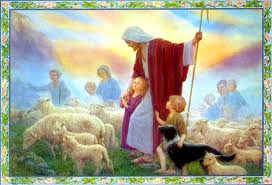 Gospel of Mark, chapter 6, we read that “when he went ashore he saw a great crowd, and he had compassion on them, because they were like sheep without a shepherd. And he began to teach them many things.” One of the most important things that Jesus taught the people in the Gospel of John is that He is the Good Shepherd.
I am the good shepherd. I know my own and my own know me, just as the Father knows me and I know the Father; and I lay down my life for the sheep. And I have other sheep that are not of this fold. I must bring them also, and they will listen to my voice. So there will be one flock, one shepherd. For this reason the Father loves me, because I lay down my life that I may take it up again.
Jesus, the King of Kings and Lord of Lords, the ultimate, supreme Ruler, gave His life for His sheep. The Good Shepherd died, so that we might live. Then He rose from the dead, rose to heaven in glory, and now rules His people with the heart of a shepherd, because He loves us and wants us to be happy.
**** **** **** ****
The picture of God as Shepherd demands a God who cares. Being a Shepherd is about caring. The motivation for God’s care is his goodness. Allan Coppedge, from his book, Portraits of God
I was released from prison last Tuesday at 5:43 pm. A prison guard walked me to the main gate, put his key in the lock,opened the huge metal door and let me out. I was a free man. It felt great to be free, to be liberated from the iron bars and concrete walls. But I was also thinking of the friends that I had left behind. Bernardo, Aries, Guillermo, Armando, and Marzalino to name a few. I was sad that they were still doing time. Oh well, I thought, I will be able to encourage them next Tuesday.
Your see, I teach an English class at a prison that is across the highway from Cristo Por Su Mundo, (Christ for the world), home for needy children, where I live with my family, and participate with God in helping “the least of these” as Jesus referred to the oppressed and downtrodden of the world. These include the children and prisoners that most of humanity forgets about and leaves behind. Every Tuesday afternoon I walk across the highway and enter a whole new world. I get to leave after a few hours. My students, my friends, have to stay.
One day I was walking alone in the hills that surround this mission. This was about five years ago. I was talking to God about my life. I was thanking Him that he allowed me to cooperate with Him at the home for needy children. I was thinking how fortunate I am to be participating in the Divine Nature that Peter talks about in 2 Peter 1 (see my last blog). Part of participating with God is to make beauty; to make the world a more beautiful place everyday, and I am able to do that by planting and maintaining the gardens here at the mission. But I was thinking, what else could I do? God, what else do you want me to do? What else can we cooperate on in helping this hurting world? Then the verse from Matthew 25, “I was in prison and you did not visit me.” The words of Jesus on the last day, judgement day, convicting me.
The mission already had a couple of preachers and teachers who would go to the various prisons in the area to minister in word and song, and I felt like I could and should do something different, to reach out to other prisoners and help them in a way that they could get a sense of the love of God, without a Bible preacher or teacher. The idea came to me that I could teach an English class. Before I came to Mexico, I had never taught English, but I realized that the most important thing about being a teacher of anything, is to simply know more than your students. So I decided I was qualified and at the request of some people here at the home for needy children, I began teaching English. That was going well, so now I would be going across the highway to the prison to see if anyone there wanted to learn English. There was- and I was there to stay, at least for about three hours every Tuesday afternoon.
All my students are great. I can’t believe any of them have done anything to deserve prison. I have never asked any of them why they are, or were, there. I don’t think it is any of my business. When I see them, I don’t want to see them as murderers, thieves, rapists, drug dealers or extortionists. I want to see them as people who were created in the image of God, people who have made mistakes in life, as I have. People who want to learn English, but more important people who want a friend, people who want to hear the Good News of God’s love, even if it is in the context of an English class. The students come and go, both to class and to and from prison. Two of my students were released, and within months were back in prison, back in my class. Most have been released and are leading productive lives.
I don’t understand a lot about the Mexican judicial system, but it seems that you are guilty until proven innocent, and you don’t get a trial before a judge. What happens is you are accused, sent to prison, and then your lawyer writes to the judge, explaining your side of the situation, then the other lawyer answers with a letter, and it goes back and forth like that until the man is declared not guilty and gets out of prison, or is found guilty and continues to live behind bars. This process can go on for years. There are two sections to this prison; one for people who have been conviction, the other for dozens of men and women who are “on trial” in their cells. One of my favorite students, a very intelligent man, who speaks remarkably good English, has been in prison for the whole time I have been teaching, waiting for his case to be resolved.
I have had some students who have been in prison in the U.S. and in Mexico. I ask them what is the major difference. They tell me that if you are in prison in the U.S., you are probably guilty. If you are in prison in Mexico, there is a good chance that you are innocent.
The situation for many in prison in Mexico is tragic. Many prisoners feel helpless, and that their situations are hopeless. I thank God that He reaches out to those men and women behind bars and concrete walls, and reaches into their hearts with hope, mercy, love and grace. While many suffer injustice from the system, they receive joy and peace from God. While the government says “You are to live incarcerated in prison” God says, “You shall know the truth, and the truth shall set you free.”
I thank God that I am free, on the outside and the inside. I also thank God for setting the captives free; free in spirit; free in heart; free in soul. Those whom the Son sets free, are free indeed.
***** ***** ***** *****
Stone walls do not a prison make, Nor iron bars a cage ;
Minds innocent and quiet take that for an heritage;
If I have freedom in my love, and in my soul am free,
Angels alone, that soar above, enjoy such liberty.
Richard Lovelace (1618-1658), from To Althea, from Prison
***** ***** ***** *****
Next blog – Life in One Mexican Prison
I have been stuck In 2 Peter chapter one for a couple of weeks now. It is a rich chapter and also a bit difficult to understand in certain places. I don’t like to leave a chapter until I have sucked all the meat out of it that I think is possible . Thus I am still I this chapter. It’s amazing how you can spend so much time in one portion of scripture, reading it and rereading it, and about the time you think you are ready to leave it, something jumps out and surprises you. That happened a couple of days ago. I was surprised by divine nature. Peter tells hos readers that God has promised we are participants in God’s nature. I had read that verse a dozen times and never thought much about it. This time it stunned me to think that God wants me to participate in his divine nature. To be his servant , sure , that’s obvious. To obey his commands, of course. To be a part of his kingdom and to work for it, I think all Christians understand that. But to participate in his divine nature? That is definitely out of this world. I can much more readily identify with Paul when he says that he is the worst sinner (I thought I was); I know where the guy is coming from who said “Lord, I believe, help my unbelief”; it is easier for me to understand King David and his foibles then to imagine God wants me to participate in his divine nature.
So what on earth could Peter possibly mean about participating in God’s divine nature? Peter says in the previous verse that God has promised us this. I have been reading the bible for at least 45 years, and I couldn’t recall any promises to this effect. I was mentally seeking out these promises and was drawing blanks. One promise I do remember is that those who seek will find.
The next morning, during the regular devotion time we have at the home for needy children where I participate here in Oaxaca,Mexico, the person that was speaking had us look at the gospel of John, chapter 14. There they were, a whole bunch of promises from the very lips of Jesus. He promised his followers that the father would dwell in them, Jesus himself would be in them, and if that wasn’t enough, they would be filled with the Holy Spirit. The whole trinity is in me! How’s that for participating in the divine nature?
John 14 promises – I will ask the Father, and He will give you another Counselor to be with you forever…
I am in my Father, and you are in me, and I am in you.
If anyone loves me, he will obey my teaching. My Father will love him, and we will come to him and make our home with him.
Also John 15 – If a man remains in me, and I in him, he will bear much fruit.
If you obey my commands, you will remain in my love, just as I have obeyed my Father’s commands and remain in His love. I have told you this so that my joy may be in you, and that your joy may be complete.
So there it is – God has decided that us frail, mortal, weak, humans can participate in His Divine Nature. God certainly loves us and wants us to be happy! Enjoy God and His Divine Nature, today and everyday!
***** ***** ***** *****
Jesus was now in charge; he was already, now, calling the nations to account. And he was going to do so through his followers, those to whom he had given his Spirit. This, whether we like it or not, is where we come in.” N.T. Wright, Simply Jesus
***** ***** ***** *****
Next blog – Released From Prison
Last week the Family Schwab went on a little vacation to Puerto Escondido, our favorite sea-side city. There is a tiny cove we like to go to. Normally the waves aren’t so big and Sally and Kelly can play in the water. Last week was strangely different though. The waves were huge, and it wasn’t safe for my little ones to go into the ocean, so they contented themselves playing in the sand on the beach.

playa carrizalillo (Photo credit: Wikipedia)
There was an elderly man that was not content to simply lie on the beach and just take things in. He was in the water sitting among some rocks. One wave crashed into him and down he went. I was concerned that he had whacked his head against a rock. He looked a bit discombobulated for a few moments, and then returned to his original position among the rocks. I settled into a comfortable position to read my book, occasionally looking up to see how the octogenarian was fairing. He seemed to be enjoying himself immensely.
At one point, an unusually large wave hit the beach, and down went the old man, tumbling wildly, flailing away helplessly, as the surf did its best to pound the guy into submission. His wife noticing what had happened, jumped from her beach chair and rushed, as fast as an old lady can rush on sand, toward her husband. I wondered how she could possibly help him. Then I realized she wasn’t going out to help him. She was going out to laugh at him. Making her way to the waters edge, she was busting a gut, she was laughing so hard. Her spouse finally got to his feet, got stabalized once again, and then he too, started laughing. It was a wonderful sight to behold. An elderly couple, laughing like children, at the beach, thoroughly glorifying God by enjoying Him and His creation.
Later that evening, Anita, the kids and I were at our hotel, which has a large, common balcony overlooking Puerto Escondido and the bay. I enjoy relaxing on the balcony, looking at all the night lights reflecting off the water. One light was from a light house. It was flashing and rotating, warning sea captains away from the jagged cliffs. Another light that caught my attention was a great search light, moving back and forth in the night sky, probably inviting tourists and townsfolk alike to some kind of grand opening or special event.

faro de puerto escondido (Photo credit: Wikipedia)
Of course there were thousands of normal lights fringing the bay, illuminating houses, and making the streets and walkways visible and safe. The main highway through Puerto Escondido runs right in front of our hotel. Looking out from the balcony, I can see a fairly constant flow of traffic. Lots of taxi’s, trucks, buses and motorcycles. At one point I saw a motor scooter coming down the way. It carried a what seemed to be a family of three. The driver stopped his scooter at a wide spot in the road, right in front of our hotel, under a street lamp. The lady and child got off the bike, and then the man parked the motorcycle as far to the edge as he could. The lady opened her backpack and proceeded to take out some food and something to drink. It seemed they were having a little picnic, under the street light, on the edge of the road. There was a small ledge there for them to sit on. They seemed not to mind the traffic flowing by. They had a light to see their food, to see each other, and the cars speeding by could see them. What could be better?
Thinking about these different lights reminded me of Jesus. He said he was the “Light of the world”. I thought his light as a lighthouse, keeping people from making shipwreck of their souls on the rocky cliffs of sin, bad-gunky, and evil. I thought of his light as a search light, spanning the world, inviting people into the kingdom of God, into a right relationship with him, into community. I thought of His illuminating light that offers people a safe place to enjoy communion with him, to enjoy peace, while the mad world whirls by. His light that shows me the truth of his love, mercy and grace.
I am so happy for His light in my life. His protecting light. His inviting light. His illuminating light. And I know that He wants me to reflect this light in a dark world. He wants me to shine a protecting light, an inviting light, and an illuminating light. God wants all of us to make this world a brighter place. Let’s do it.
**** **** **** ****
“Let your light so shine before men that they may see your good works and glorify your Father in heaven.” Matthew 5:16
**** **** **** ****
Next blog – Participating in the Divine Nature

Life with Mikey (Photo credit: Wikipedia)
My ten year old daughter Tifani had broken the rules and needed to be punished. I don’t remember what offense she had committed. I just remember looking at her, shaking my head, letting her know that she had disappointed me by breaking the rules and that she was going to be punished. She looked up at me with big, sad eyes and said, “I’m bad. I know it. Daddy, I need help.”
When I heard her utter those words I burst out laughing, all my anger gone, knowing that my budding little actress had obviously picked up this line from some movie she had watched. All thoughts of punishment had disappeared and I asked her where she had heard those words, “I’m bad. I know it. I need help.”
She had recently watched a movie called LIFE WITH MIKEY, and in this movie, a young girl about Tifani’s age was a pickpocket on the streets of New York. She gets caught and an angry man accuses her of stealing his wallet. A small crowd gathers around her. Michael Chapman (Michael J. Fox) shows up. He had just had his wallet stolen by this same girl. He is the head of a child talent agency, and is always looking for new talent. He sees the way that this girls is playing the crowd, and realizes that she is a natural. He intervenes, telling everyone that she is his daughter. Crocodile tears pour down her pretty little face and she exclaims, “I’m bad. I know it. Daddy, I need help.”
She made the confession, “I’m bad. I know it. I need help”, not out of any realization of her true nature, but in the hope that people would feel sorry for her, give her a break and let her go.
Her words, though, have great significance for those who want to enjoy God. The life of enjoying God begins with the startling revelation that we are all bad. That we really and truly Know that we are bad and that without help, we are doomed.
This thought, for many, is the hardest part of enjoying God. In fact, it seems ridiculous! When confronted with the possibility that we might be bad, we immediately present our first list of all the good things we do. We give to charitable organizations and donate time to worthy causes and don’t beat our wives or children and work hard at the office and never cheat or steal.
Our second list is made up of truly bad people like murderers, rapists, thieves and those who cheat on their spouses and take advantage of the poor. We can always point to those who are really bad and thus exonerate ourselves.
Everyone has their own categories of who is bad and what is bad and we certainly don’t fall into any of those categories. But, the category that matters most, is God’s category. Since He is the one we want to enjoy, and it is He that gives the joy, it is His standard of Good and Bad that we need to take a look at.
In the Bible God reveals His character and ours. He shows us His standard of goodness and also how far removed we are from that standard. The Bible tells us in no uncertain terms that because we do not live up to His standard of Goodness that we are His enemies (Rom. 5:10). Indeed, we are dead in our badness. Dead in our sins as Paul puts it Ephesians 2. Sin is just another word for bad, a type of bad that utterly offends a perfect God, and totally blocks our any chance of enjoying God. In Romans 3:12, Paul quotes Ecclesiastes 7:20 saying, “All have turned away, they have together become worthless; there is no one who does good, not even one.” Even the good deeds we do, the random acts of kindness we perform, the rewards we receive for helping others, are all a stench in the nostrils of God, if done apart from being in right relationship with him.
Help Is Available
This is where the Good News comes in. We can’t enjoy the God the Good News if we don’t first understand the bad news. The bad news is that we are bad. The Good News is that help is available!
The last phrase the girl pickpocket declared when confronted by the angry victim was, “I need help.” She was insincere in her claim of needing help. If we truly believe from the bottom of our hearts, that we re bad and desperately need help, God is more than willing to come to our aid and rescue us.
I lived in Sonoma County, California, for a number of years. There were a few years that we experienced terrible flooding. I lived close to the RussianRiver and during a particularly bad flood many of the residents were surrounded by high water and had to be helicoptered to safety. Those residents recognized they were in a bad way and were glad to be helped.
I remember one especially dramatic photograph that appeared in the local paper. A man was being rescued from the raging river by a fireman who was in the river with him. The fireman was roped to other firemen standing on the bank. The drowning man was rescued and the photographer went on to win a Pulitzer prize for the photo.
When we come to a point where we realize that we are drowning spiritually, when we realize that joy, peace and contentment are not the hallmarks of our lives, and that the turbulent waters of depression, disappointment, frustration, anger and disillusion threaten to overwhelm us, and we call out to a merciful, compassionate and gracious God (Daddy), He will rescue us!
In a way, God is like the fireman who jumped into the river to save the drowning man. God jumped into our hopeless, helpless situation, into our badness, in the person of Jesus Christ. And all those who became aware of their badness, and followed this God/Man Jesus were rescued, and are still being rescued and given new lives. Lives filled with joy in God and delight at being delivered from the turbulent flood called existence, and brought onto the safe shore called Life. Life enjoying God.
Some, like many of the religious leaders of Jesus day, didn’t realize how dire their plight was, and chose to cling to the slippery and perilous branches called self-righteousness and good works. They perished without ever experiencing the joy of knowing God.
Bad Gunky
Unfortunately, that isn’t the end of doing bad things. While we celebrate and rejoice that our Bad Existence was put to death by Jesus, we still struggle with doing bad things. Martin Luther said we are at the same time righteous and sinners and that we continue to wrestle daily with the World, the Flesh, and the Devil. I call these things Bad Gunky. In Stephen King’s novel LISEYS STORY, one of the main characters explains to his wife, Lisey, all about bad gunky. As a child he lived with his father and older brother. At various times they were attacked by what his father called “bad gunky”. This was an evil presence that would, without warning, fill either the father or one of his sons with a violent anger that would cause them to want to kill. The only cure that normally worked to rid the family member of bad gunky, was the shedding of blood. One of the family members that was not being attacked by the bad gunky would have to inflict a large, deep cut on his own body, to set the other family member free of the evil known as bad gunky.
This is a wonderful picture of what our Brother, Jesus, did for us, giving himself up freely to be crucified, to let his blood pour down the cross, so that we could be free from bad gunky, the power of sin, of badness, that caused our spiritual death. Bad Gunky, with a capital B and a capital G is no longer a threat to our eternal relationship with God, to our eternal life. However, bad gunky, small b, small g, still nips at our heels and barks in our ears on a daily basis. This bad gunky tempts us to do bad things. Tempts us to leave the Lord we love. We fall victim daily to bad gunky. Jesus tells us we are to love God with all our heart, with all our soul, with all our mind, and with all our strength. He tells us to love our neighbors as we love ourselves. We fail at this everyday. In fact it is an impossible task. So what sets followers of Christ apart from the rest of humanity that fails everyday? It is the fact that as followers of Christ we have as our life goal to love God with all our being, and to love our neighbor as we love ourselves. We know this is the surest way to a life full of joy with God and with each other. We begin the day in prayer, asking God’s Spirit to come along side us to help us love as He wants us to love. And, if we are to be honest, end the day in prayer, noticing the ways we have failed to love, and confess to God that we have not loved Him with all our heart, all our soul, all our mind and all our strength. That we have not loved our neighbor as our self. And we rest assured, knowing that God is faithful to forgive us our sins, our bad actions, our lack of love. We sleep peacefully, knowing that our merciful, compassionate, patient God has washed away the bad gunky of the day. We look forward to the morning when God’s mercies are new and we can experience afresh the joy of God.
**** **** **** ****
The great power of God appears in bringing a sinner from his low state, from the depths of sin and misery, to an exalted state of holiness and happiness. Jonathan Edwards (1703-1758) from his sermon God Glorified in Man’s Dependence
**** **** **** ****
Next blog – God Didn’t Have To, But He Did
My wife Anita, our two daughters and myself were in Mitla, Oaxaca, Mexico a couple weeks ago, helping with the

Anita serving up atole
preparation and joining in the celebration of Radio Zapoteca’s second anniversary. Wood fires were burning in cinderblock rings. Smoke filled the cooking area and escaped through slits in the rusted tin walls. Milk, ground up oats and sugar were mixed together in a big pot over one fire to make a traditional Oaxacan drink called atole. Chickens, throats freshly cut, were briefly plunged into boiling water of another pot and then plucked naked. Nine butchered chickens contributed to some delicious chicken soup and tasty tamales.
Women from a half dozen local church congregation gathered in Anita’s parent’s yard to help. Some churches donated food, others tables and chairs. The Home for Needy Children, where Anita and I are staff members, donated cases of milk. I wrote in an earlier blog that the social service arm of of the government had given the ministry a bunch of milk. Out of our abundant supply we were able to share. Blessed to be a blessing, as the saying goes.
Anita’s older brother, Arturo, started Radio Zapoteca two years ago, because of his vision of proclaiming the Good News that God loves us and wants us to be happy, to the entire Mitla valley. This wonderful  Christian radio station plays inspiring Christian music, and proclaims the messaged of God’s love in Spanish and the local Zapoteco dialect. This station also broadcasts via the internet at RadioZapoteca.com if you want to give it a listen.
Arturo is an inspiration himself. Fifteen years ago, Arturo was living for himself. He graduated from the local university with an accounting degree and immediately got a good job making good money. God spoke into his life through local missionaries, who convinced him, with the help of the Holy Spirit, that there was more to life than money and mezcal. He turned his life over to the Good Shepherd and Savior of his soul. He was filled with a joy that he had never experienced

Cooking tubs of tamales
before. He gave up his job and went to work for the missionaries, helping them make recordings of the Bible in the dialects of illiterate village people living in isolated areas of Oaxaca (RadioZapoteca.com includes Bible recordings of over 400 dialects).
He worked faithfully in that ministry for a few years, while being heavily involved in a local church. The little church, Dios Es Amor (God is Love), was the result of a church planting of a larger church in Oaxaca city. The idea was that after a few years, it would become self sufficient with its own pastor. Arturo had been in charge of the youth group and would preach occasionally. The pastor of the parent church in Oaxaca city saw the hand of God on Arturo’s life and Arturo felt the call of God to pastor the little flock. After receiving pastoral training, and much prayer, Arturo was ordained as pastor of Dios Es Amor.
Over two years ago, Arturo began dreaming of a way to communicate Christ, not just to his small band of brothers and
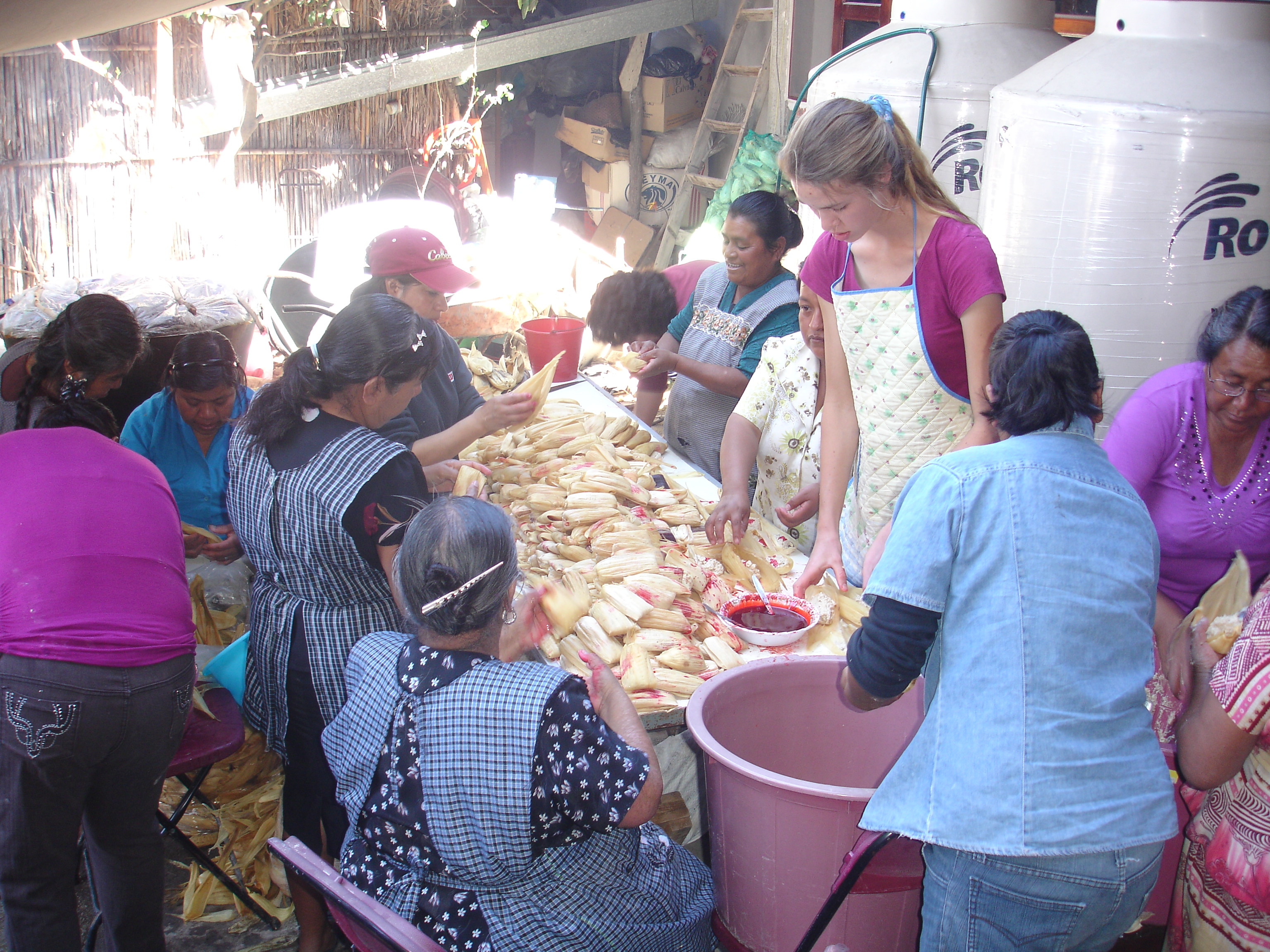
Sisters in Christ helping to prepare a feast for the fiesta
sisters in the Lord; not just to his neighbors and those he would casually meet, but to all of the Mitla region. He envisioned a Christian radio station that would proudly proclaim the gracious goodness of a living Redeemer, not just to the Spanish speakers, but to those indigenous people in the area called Zapotecos and spoke that dialect. Arturo could reach out to them in their “heart” language, since he was half Zapoteco and could speak the language.
He shared his vision with other Christians and they began to dream the same dream, and supported Arturo with
prayers, funds, time and talents. Two weeks ago, these Christians, along with hundreds of others who regularly tune in to Radio Zapoteca, came together in the town square to celebrate the radio station’s second year of existence. Pastors of different denominations spoke about the importance and blessing that Radio Zapoteca was for them personally and for their congregations. People spoke about how much more they enjoyed God when they could turn on the radio and listen to inspiring Christian music, teaching and preaching. Bands came from all around to play their different styles of music, glorifying the King of kings and Lord of lords.
Standing in the smokey, makeshift kitchen of my in-laws, surrounded by sisters in Christ cooking chickens and making

Arturo broadcasting the Good News on Radio Zapoteca
tamales, I rejoiced in God’s work and goodness. I thought of all the Christians in the community that were encouraged daily by Arturo and Radio Zapoteca. There were so many who had come to know our Great, Good God, and were themselves helping to grow the Kingdom of God in their own special ways. And on that Saturday in February, we were all together, pitching in, to make the second anniversary fiesta such a success – glorifying God and enjoying Him and His presence among us.
* * * *
Guiraa redee badeedni te guluiireni rexpejn Jesucrist, te gunreni dzuun te gustajlreni rebejn ni gac xquidoo Jesucrist. Zapoteco de Mitla translation of Ephesians 4:12 – to prepare God’s people for works of service, so that the body of Christ may be built up.
* * * *
Next blog – Beauty, Truth and Goodness
 To Enjoy God