
You are currently browsing the category archive for the ‘Uncategorized’ category.
I haven’t written for awhile because Anita, the girls and I went to the United States for a month. We had not been there for four years, so we had a great time visiting family, going to a Giants game in San Francisco, Disneyland in L.A. and camping in the Rocky Mountains. I loved driving on pot hole free roads and using free bathrooms that had toilet paper, toilet seats, hot water and paper towels. I encountered no crazy taxi drivers, never heard a honking horn and saw no graffiti and little litter. These are things most Americans take for granted. In Mexico these things are the exception.
But I am glad to be back at the Mission in Oaxaca. Why? Because, while we don’t have the best roads, nicest bathrooms or cleanest cities, we do have, in my humble opinion, the finest people serving at the greatest Mission in the world. The people serving at the Home for Needy Children in Oaxaca could work almost anywhere and make more money, if money was their priority, but it’s not. Their priority is loving God with all their being, and loving their neighbors as they love themselves. Their priority is helping the poorest of the poor in Mexico. Their priority is bringing help, hope and love to the downcast, oppressed, abused and mistreated children of this poor land.
Now I am back with these fine people and enjoying seeing formerly sad children smile, discouraged little girls encouraged, angry little boys at peace, hungry teens well fed and losers at life’s sometimes vicious game, given another chance at happiness and contentment.
Of course, all of this is made possible by the grace of God, the prayers of the saints and the contributions of people who care. Thank you God for people who care!
***** ***** ***** *****

Sometimes people have trouble believing that God loves them and wants them to be happy. Some people have never believed it and others used to believe it. I was reading Luke 5 the other day and encountered four men with these same struggles.
The first was Peter. He was having a bad day because he had had a bad night. Out all night on his boat fishing, trying to make a living, provide for his family, and didn’t catch a single fish. Not even a minnow. He was cleaning his nets when along came Jesus. Peter had heard of this Jesus guy. Supposed to be some new phenom rabbi who went around preaching, teaching and supposedly healing people. Large crowds followed him wherever he went, and this day was no exception. They were jostling him, pushing babies at him to bless, and begging to be healed. Jesus needed some space. He saw Peter’s boat on the shore, and asked Peter if he would row him out away from shore. Peter sighed heavily, looked at his nets, and then at Jesus. He stood up, walked towards his boat, helped Jesus in, then got in himself and rowed out always. “At least I get a front row seat to the Jesus show” he thought to himself.
Peter was strangely moved by this itinerant preacher. He could see why people were taken with him. He had an engaging smile, told interesting stories, spoke with authority that Peter had never heard before. He was actually a bit disappointed when the good teacher was through. But then discovered that although Jesus was finished preaching, he wasn’t finished with Peter.
2. The second man Jesus encountered knew he was a sinner. His body was full of leprosy, a judgement from God for his sins, at least that’s what everyone had told him, although he had trouble thinking what sins he had committed that merited such punishment from God. He was upset at God and couldn’t believe that God loved him and wanted him to be happy. There was a time in his life when he thought That was true. When he was caressing his beautiful wife and playing with his children. Now that had all changed. He wasn’t even allowed to be close to his family since the leprosy invaded his body. Now he was an outcast, societies reject, who had to live alone, or with a few other lepers. Anytime he went near another person, or someone approached him, he had to warn them with cries of “Unclean. Unclean.” He couldn’t remember the last time he had touched someone, or that someone had touched him. Happiness was now a foreign idea to him. A loving God was none existent.
3. The paralyzed man could identity. He wondered how a loving God could see him in his condition and not do anything to help him. He too, thought about sin, and wondered if he had done something so bad that he had to endure punishment from a wrathful God. That was the majority opinion at the time, and while a few kind people would occasionally help him out with a shekel or two, he figured they were thinking that he brought this malady on himself one way or another. “At least I have my friends” he thought.
4. Levi didn’t know and didn’t much care if God loved him and wanted him to be happy. He believed that you have to make your own happiness, and for him, making happiness meant making money, and lots of it, even if it meant taking it out of your brothers pocket and putting it in your own. Levi was a hated tax collector, working in collusion with the Roman government who ruled Israel. With these two strikes against him, he was despised and rejected by his fellow citizens. Never invited to his neighbors parties or celebrations. Banned from the synagogue. “Who needs them?” He often exclaimed. “I have the nicest house in town, eat the finest foods and drink the best wine!” This was his outward persona, but inside he felt something was missing. He was restless, always looking for the latest, greatest pleasure that would finally drown the gnawing feeling of discontent that he struggled with continuously.
I think that if we put ourselves in these guys sandals, we might also have trouble believing that God loves us and wants us to be happy. Christians all over the world, everyday, struggle with pain, rejection, financial difficulties and disappointment with God. By seeing how Jesus stepped into the lives and situations of the four men from Luke 5, we can get a glimpse of how he might make a difference in our lives and situations.
With Peter, after his teaching the crowd, Jesus told Peter to go into the deep water, let down his nets, and see what would happen. I’m sure Peter was skeptical. Jesus was a good teacher and healer, but what did he know about fishing? It turns out, plenty. Peter’s net was bursting with fish. His heart was bursting with shame. He realized that more than a man was in his boat, and Peter recognized his sinfulness and unworthiness to have Jesus in the same boat with him. Peter asked Jesus to leave because he felt so unworthy. The compassion of Jesus flowed into Peter when Jesus, told him, “Follow me, and you will become a fisher of men.” A bad day for Peter turned into one of the best days of his life. That’s what happens when we let Jesus into our boat.
The leper had heard about Jesus the healer, and hoped it was true. But even if it was true, would he have anything to do with a filthy, sinful, leper. He wanted to find out. As Jesus passed by the leper fell with his face to the ground before Jesus and begged him, saying, “Lord, if you are willing, you can make me clean.” Unbelievably, Jesus reached out his hand and actually touched the leper, something prohibited by Jewish law, but something greater than the law was present. The compassion of Jesus – and the leper was healed. He knew indeed, that God loved him and wanted him to be happy.
The paralyzed man wanted to experience the healing touch of Jesus. His friends took him to the house where Jesus was teaching and healing people. They couldn’t get the guy and his mat into the house because of a huge crowd of people trying to get at Jesus. One of the friends had an idea. They went to the roof, took off a few roof tiles, and the next thing you know, the man was being lowered down before Jesus very eyes. Surely the paralyzed man was excited, expecting Jesus to heal his crippled legs, and oh the joy that would fill his soul.
Jesus looked at the paralytic, called him “Friend”, and then said in a loud voice for all to hear, especially the Pharisees, “Your sins are forgiven.” I imagine the man on the mat was somewhat confused. He had come to be healed, and now Jesus is forgiving his sins. What is that all about? The paralyzed man’s greatest problem was not with his legs, but with his heart. His heart was crippled by sin and resulted in guilt, inner turmoil, and separation from living in right relationship with God. First things first. Jesus dealt with the heart situation first, and in the process let the large crown in on a little secret, that he was not just a man, but that he was also a compassionate God who heals hearts as well as bodies. After forgiving his sins, he heals his legs and the guy walks out, carrying his mat, rejoicing in the new found knowledge that God loved him and wanted him to be happy.
Finally, Jesus makes a difference in the life of Levi the tax collector. Jesus went up to Levi, greedily collecting the peoples money, and spoke to him. “Follow me.” Something incredible happened to Levi. Again, it was a heart thing. A heart change. Open heart surgery or a heart implant, where the Holy Spirit opened the spiritual eyes of Levi, softened his heart, and made him realize that there was more to life than money and materialism. Luke 5:28 tells us that Levi got up, left everything and followed Jesus. Now Levi’s life had real meaning, a true purpose and he was filled with great joy. God loved him and wanted him to be happy.
God comes to people lives in many different ways and usually at the most unexpected times. Sometimes it happens when we seek him, other times when his presence is the last thing we are looking for. But he always shows up to let us know that he loves us and wants us to be happy!
***** ***** ***** *****

In Mexico Mothers day is always on May 10th, and in America it’s always the second Sunday in May.  This year they are both the same day. Remembering our mothers is a big deal in both countries. We remember the love they showed us, the hugs and prayers, the special meals they made for us, the bedtime stories and a hundred other things that each of us have tucked away in our hearts when we think of MOM. We honor our mothers in special ways on her special day. I always send flowers to my mother and call her on this special day, because, after all, she is the most wonderful mother in the world.
We not only have a special day to remember Mom, but we have certain days throughout the year when we remember important people and events in our history. We have days to honor soldiers who have given their lives for their country. We have Memorial Day in which we remember loved ones that have passed on. Remembering special people and events seems to be much more important in Mexico than in the United States. In the U.S. we have some holidays to remember people and events, but a lot of times they are excuses for three day weekends and not a lot of remembering actually takes place.
My six year old daughter, Sally, is part of the flag team at her kindergarten. Every Monday she marches with her team at the start of the school day. Every child sings the Mexican national anthem and recites their pledge of allegiance. Throughout the school year her flag team joins all the other flag teams of Tlacolula, Mexico, in different places around town to honor and remember important people and events in Mexico’s history. Naturally, Anita and I take Sally to these events. Here is a list of all the ceremonies  we attended this last school year:
Death of the boy heroes, Shout for Independence, Independence day, Consummation of independence, United Nations day, Anniversary of the Mexican Revolution, Anniversary of Mariano Matamoros, Constitution day, Anniversary of Vicente Guerrero, Birth of Benito Juarez, Death of Emiliano Zapata and finally, the Battle of Puebla.
That is a lot of remembering. I like it. At each ceremony the leaders of the town are in attendance, and someone gives a speech about the significance of the person or event that is being celebrated. All of these ceremonies take place every year, to insure that the people, especially the children, know their history. When people know their history, they have a better sense of who they are and where they came from.
Remembering is important to God and the Bible. In the Old Testament, God is forever telling his chosen people to remember. Their greatest failures occurred when they forgot. They forgot Abraham, Isaac and Jacob. They forgot the Passover, they forgot crossing the Jordan River into the Promised Land. They forgot how God delivered their enemies into their hands. They forgot the Law of God. Most importantly they forgot God himself.
Remembering is important in the New Testament as well. When Jesus had his Last Supper with the  disciples, he held up the cup of wine and the bread, and said, “Do this in remembrance of me.” When we partake of Holy Communion, we remember Christ’s broken body and blood shed on the cross for the remission of sins. We remember that because of the sacrifice of Jesus, we live joyous lives in right relationship with our heavenly Father. We remember that He loves us and wants us to be happy. We remember who we are and how we got here. Let’s never forget.
This post is dedicated to my wonderful mother, Carolyn Schwab. I love you Mom!
***** ***** ***** *****
Lest I forget Gethsemane,
Lest I forget Thine agony;
Lest I forget Thy love for me,
Lead me to Calvary. Jennie E. Hussey
For me, to sum up what the Bible is about, from Genesis to Revelation, I would have to say creation, destruction and restoration.
In Genesis chapter one, God creates the universe in six days. At the end of each day he pronounces  that what he had created that day as good, beautiful, perfect. On the sixth day he created male and female in his image and declares that act of creation as Very Good. In chapter two we read that he created a garden with beautiful trees laden with fruit. Thus we have an incredibly beautiful creation of God, intended for mankind to enjoy.
Unfortunately it ends all too soon. In chapter three of Genesis, destruction happens. Adam and Eve disobey the only command God gives them. They eat of the tree of Knowledge of Good and Evil. That knowledge destroys their intimate relationship with the Almighty Creator. It destroys their relationship with each other. The eating, the disobedience, destroys their relationship with the earth and all that is within it. They receive the Curse of God, and are denied the perfect creation of God. They are expelled from the garden.
Much of the Old Testament gives us an account of more destruction. Cain destroys his brother Able. God destroys the earth with the great flood. Armies destroy armies. Nations destroy nations. Kingdoms are wiped out. It’s all bad. Almost.
God did not leave humanity without hope. Even as he pronounced curses on Adam and Eve, he slips in a promise of restoration. Something to look forward to. He promises that one day the Seed of Woman would crush the head of the serpent (Genesis 3:15).
God began the slow, but sure promise of restoration by choosing one man, Abraham, to be the father of a great nation. He chose an enslaved nation to escape their slave masters and become a powerful, godly nation. He revealed himself, his will and his laws to them. He chose David, the shepherd boy, a man after His own heart, to be king over this nation. These acts were bits and pieces of restoration that pointed to a time when a full restoration would take place.
They pointed to the advents of Jesus. His first and second comings that the prophets wrote about. His birth in a manger, death on the cross and resurrection from the tomb; the first advent when God emptied himself, humbled himself and the Word became flesh. Before ascending to his place of power in heaven, he promised he would return one day to fulfill the scriptures promise of a full restoration.
Right now we live in the Already, But Not Yet. When Jesus came the first time he lived a perfect life, yet died on the cross bearing the sins of humanity that had been living destroyed, sin-filled lives and He suffered the wrath of God for those sins. Thus he cried out from the cross, “My God, my God, why have you forsaken me!”
When he rose from the dead, Ephesians chapter two tells us that those who believe in him and the work he accomplished on our behalf on the cross, were also raised to Life, meaning we now live spiritual lives in right relationship with God the Father. Paul writes that all who place their trust in Jesus are justified, which means our sins are forgiven; God adopts us as his children, and sees us “just as if we had never sinned.” Not only that, but the same chapter of Ephesians tells us as Christ rose to take his place of power in the heavenly realms, we also are seated with Him in the heavenly realms. An incredible act of restoration took place.
When we look at our lives we can clearly see that we are not in heaven and that we continue to sin  everyday. So what gives? What kind of restoration is that? That is where the “Already, But Not Yet” comes in to play. While our lives are incredibly better in Christ, they are not perfect. While we experience more joy and peace than ever before, we continue to struggle with times of conflict and sadness. That is the “Already” life. The “Not Yet” restoration fullness will take place at the end of the age when Jesus returns to set up his restored kingdom, which, according to the last couple chapters of the Bible, look a lot like the first couple chapters of the Bible. It’s a perfect creation where there is no more sin and suffering; where there is a River of Life and fruit trees. It’s a place where destruction is a thing of the past and everyone lives in love and unity with each other and God.
So there it is. The story of the greatest book ever written, the Bible, summed up in three words – Creation, Destruction and Restoration.
***** ***** ***** *****

I have been to a lot of celebrations and ceremonies during my ten years in Mexico. Weddings, funerals, graduations, and birthdays. You name it and they celebrate it, big time, and I have attended many. I thought I had seen it all, until Saturday. Saturday I attended a “Forgiveness Ceremony”.
Initially, Anita, my wife, and I, thought we were going to a wedding. A young lady who had lived at the home for needy children, where Anita and I serve, was going to tie the knot, at least that’s what we were told by her younger sister who still lives at the children’s home. We were invited. We were told it was to take place at the Catholic church in the small town where the mother and daughter lived.
Anita and I started out for the small town early in the afternoon and upon arriving at the town we began to look high and low for the church. In most small Mexican towns, the Catholic church is the easiest thing in the world to locate as it is normally the biggest building in town, and centrally located. This church was an exception. After asking half a dozen people where the church was, we finally found it toward the edge of town, surrounded by trees. We also found it empty . Nobody was there! We called the mother of the bride and she said everyone was at her house and told us how to get there. We made our way there, and the younger sister of the supposed bride met us on the street and informed us that there was no wedding. Somehow she was confused about the purpose of the event and thought it was a wedding, but it was something else.
A lot of stuff that followed was confusing to me, and even to Anita, who has grown up Mexico. She tried to explain what was going on as events unfolded.
We went into the place. I say place because most Mexicans who live in small towns don’t live in houses so much as they live in family compounds with a few dwelling places in which immediate family members live, as well as extended family members like grandparents, aunts and uncles and sometimes in-laws. There is normally a relatively large common space or courtyard in the middle. The mother of the young lady who had lived at the mission, is poor, her husband is in prison, and she lives in a tin shack on the edge of the compound, which is owned by her husband’s brothers. This is why one of her daughters lived at the mission and another still lives there.
The mother explained all too briefly what was going on, and then led us to a table where we were served pozole, a common soup served at celebrations. We were halfway through our bowl of pozole when the action started.
At this time the only people there was the family of the mother. All of a sudden, the family of the 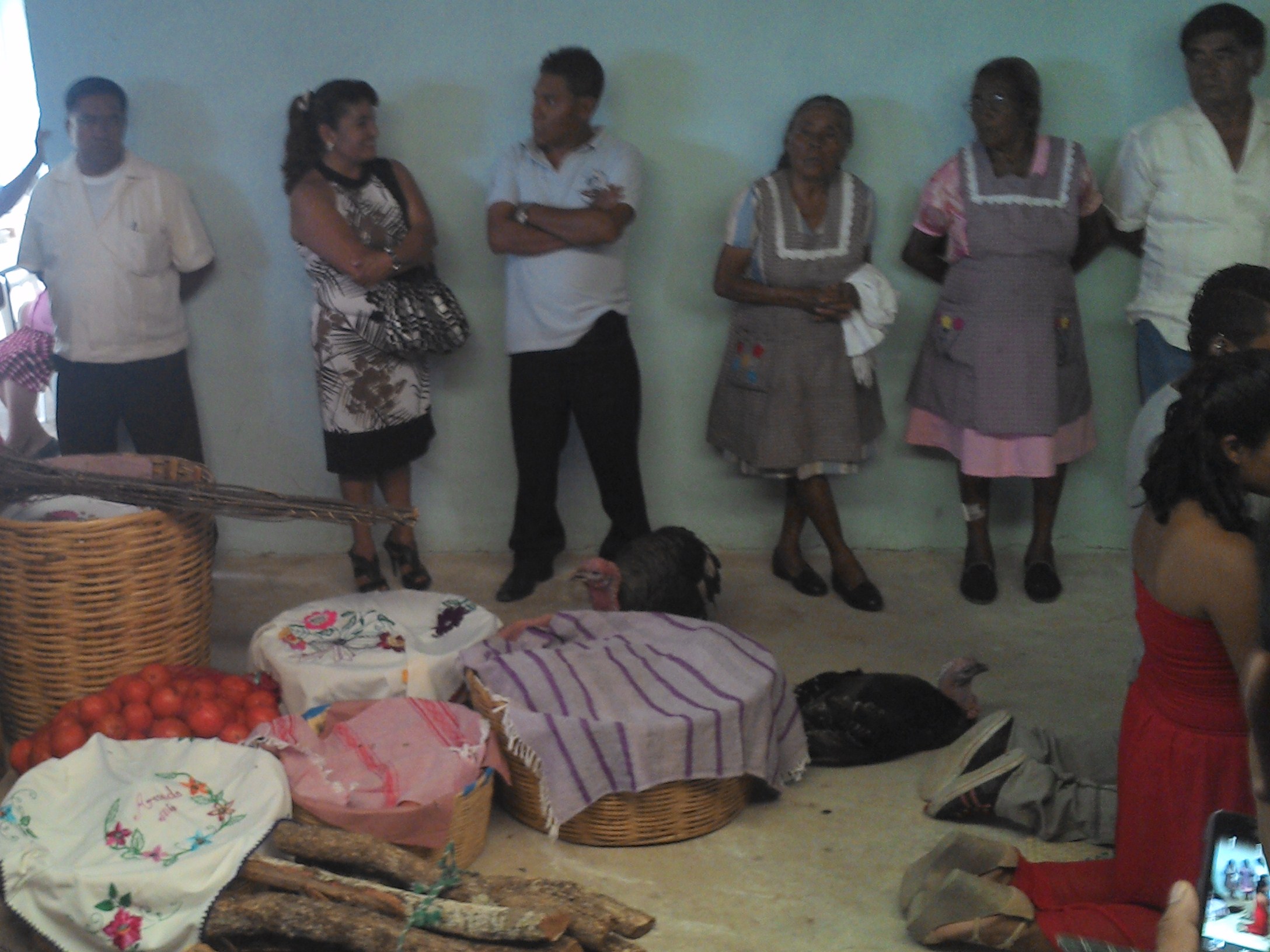 boyfriend/groom, started filing into the compound, led by an elderly woman carrying a censor from which burning incense smoke was filling the air. Close on her heels were men carrying a couple loads of firewood, a couple of bound turkeys, large baskets of food and ten cases of beer. Anita told me that in an ordinary wedding the groom and his family bring gifts such as these to begin a long (sometimes seven days) wedding celebration. But on this day, it was more of a peace offering brought by the boyfriend’s family to help make amends for an offense.
It seems the offense was that the 25 year-old boyfriend had “taken advantage” of the 17 year old girlfriend, and to add insult to injury, he had already fathered two children out of wedlock with another lady. All this didn’t seem to bother the girl who had lived at the mission so much, as she was clinging to his arm as they were the last to enter the courtyard and then walked to the front and stood between the two lines of family members; each line consisting of about 20 people.
Then the dialogue began. A man from the boyfriend’s family began by admitting that the young man had done wrong and asked forgiveness. The mother of the young lady accepted the apology and forgave the boy and ostensibly the entire family who, it seems, was considered somewhat culpable in the affair. I thought, “That was easy enough”. But the mother was not done. In fact, she was just getting started.
She exclaimed to the other family how painful the whole episode had been to her and her family and to her husband in prison. It was wrong what the young man had done and her and her family felt terribly offended by the ordeal. She was shaken by the event and her voice began to rise. Other members of the young man’s family chimed in. Members of the mother’s family spoke their piece, in tones that were less than peaceful. Discussion continued for a few minutes as the two families considered what was the best way to ameliorate the situation. Some suggested a “shotgun” wedding. Others said the couple should work it out on their own. The conclusion, as far as I could understand, with Anita help, was that they would wait until the young lady turned 18, and if they were still “in love”, then they would get married. Most people seemed to think that was the best solution, and the heart of the “forgiveness ceremony” began.
Mexico is about 95% Catholic, and most Catholic homes that I have been in have a little “shrine” in some part of the house with a virgin Mary figure, some baby Jesus’s , and a crucifix. This place was no different. In fact this whole process took place in front of the family shrine. At this point in the ceremony, the young man and young lady knelt in front of the shrine; in front of a burning candle. Then a kind of blessing/forgiveness thing took place starting with the mother and her family. The mother crossed herself before the shrine, and then made the sign of the cross over her daughter and the young man. Then she put her right hand on her daughter’s head, and left hand on the man’s head, and slowly brought the heads together until they gently touched. When I was young, I remember a person talking to a couple of children that were misbehaving, and he told them to stop or he would knock their heads together. This thought ran through my head as each member of the mother’s family, and then the young man’s family repeated this process of making the sign of the cross and then bringing their heads together. A part of me thought that both parties had acted badly, with total disregard of the scriptures, and that they did indeed, need to have their heads knocked together in hopes that it would knock some sense into them.
After all the family members had their turn to bless and forgive, and then they all applauded and pointed their fingers at family members across the little isle that separated them, as athletes sometimes do when shouting, “You’re the man!”
Then, out came the adult beverages. The mother’s family poured a little bit of mezcal, a tequila like drink that is popular in Oaxaca, into small plastic cups and gave one to each of the young man’s family, and then to her own. And if that wasn’t enough, she opened some cases of beer, and gave each person a bottle. So, with both hands holding an intoxicating beverage, they lifted the drinks in honor of the other family, as if to say, “let bygones be bygones”, and everyone took a drink.
That was enough for me. The ceremony seemed to be over and the families were setting out tables and chairs in preparation for what would undoubtedly be a long afternoon of celebration with lots of food and inebriation. We bid the mother and daughter farewell, but not before Anita had a heart to heart talk with the young couple about living responsibly before each other, their families, and especially before God.
Thinking about this strange ceremony on the way home, I thought that overall it was a good thing. All concerned parties came together to air their grievances in hopes of finding an appropriate redress to the problem, and reconciliation before God and man. They found neutral ground and a hopeful solution to the situation. Both families ultimate concern was for the well being of the young couple. The couple took it all in, was made aware of the pain and turmoil that their irresponsible behavior had caused, and then humbly knelt, while each member of both families forgave them and blessed them. It is much better than carrying around a hateful grudge the rest of their lives like the infamous Hatfields and McCoys.
I also thought of the Lord’s prayer, where Jesus taught his disciples to pray, “forgive us our sins as we forgive those who sin against us.” After the prayer, Jesus emphasized the importance of forgiveness by saying that if you do not forgive others from your heart, your heavenly Father will not forgive you. God loves us and wants us to be happy. We are most happy when we live in acceptance of God’s forgiveness and an attitude that easily forgives others.
***** ***** ***** *****

The other day in the monthly staff meeting that we have at the home for needy children, the  administrator, Jill, said she wanted us to spend the first 15 minutes in prayer. She invited those so inclined, to say a prayer out loud. She said the prayers should be short. One or two sentences. She said that because on occasion she would get frustrated with her two young children. She told us that she would be at a store and her kids would ask her for something. Sometimes she would tell tell them that yes, she would buy them a toy, but that they would need to wait. During their time at the store, the kids would continue to ask for the toy. She had already told them that she would buy it but they kept asking for it. It bothered her that they didn’t seem to believe her or trust her word. Then she realized that she does the same thing with God in her prayers. She doesn’t just ask once God for something once and then leave it in his good and loving hands, but keeps pestering God about it. for example, she cares for two children. One boy she adopted was born with hepatitis C. She kept praying for him to be healed, like God didn’t hear her the first time. She has cared for a six year old girl for almost that long. She has tried to adopt the girl for almost that long, but has had no success dealing with the Mexican bureaucracy in the adoption process, despite her many prayers.
At the staff meeting most of us prayed a simple, short prayer, and I thought that it was one of the best corporate prayer times that we have had.
Later, I told her that I liked what she had said, and agreed with her, especially since I regularly had the same shopping experience with my two young daughters. I told her that I thought Jesus agreed as well. Jesus talked about how to pray appropriately with his disciples in Matthew 6 and also in Luke. In Matthew he told his followers that some people babble long prayers and think that they will be heard because of their many words. Then he told them the Lord’s Prayer. It is easily prayed in 30 seconds, and covers any kind of a petition or concern that could possibly be on a person’s heart.
So why do so many people pray such long prayers, especially in public? At the mission we naturally pray before each meal. The other day someone prayed for about two minutes. Really, how long does it take to say “Thank you God for this food and bless it for our bodies use”?
Then there is the other side of the coin, or the tortilla, as my wife likes to say. A few days after Jill spoke, Modesto, one of our missionaries from the mountains of Oaxaca, spoke about perseverance in prayer, and I thought of Jesus teaching on persevering in prayer (Luke 18:1-8)) I also thought about Jesus prayer request at Gethsemane. He asked God to let the cup that he was going to endure, to pass from him, adding the words, “Yet not my will, but yours be done.” That seems like a short enough prayer, but when he found his disciples sleeping, he asked them why they could not pray with him for one hour? So what seems like a short prayer request was actually a long prayer.
So what does God really want? Long Prayers or short prayers? Part of the answer can be found in Ecclesiastes chapter three where the writer says there is a time for everything. There is a time for short prayers and long prayers. Also, we need to define prayer. Prayer is communicating with God. Paul tells believers in his letter to the Thessalonians to pray without ceasing. In this sense our lives are to be lives of prayer, always communicating with God. We also need to consider different aspects of prayer. Many Christians use the acronym ACTS to help them with their prayers. A is for Adoration. C is for Confession. T is for Thanksgiving. S is for Supplication or petition; asking God for things.
When we are communicating with God; adoring and thanking him, our prayers can never be long enough. We could, and probably will, spend an eternity worshiping and praising and thanking God. I have been reading Revelation lately, and over and over there are passages depicting the angels and elders and departed saints singing praises to God eternally; thanking God forever and ever. Our primary communication with the Almighty should be adoration and thanksgiving. By our attitudes, actions and words we communicate with God and with others our gratitude and love for our Creator and Savior.
Confession of our sins, faults, errors and shortcomings are a vital aspect of prayer as well. How long this part of communication lasts with God depends on the person who is praying. We would hope this aspect of prayer would not consume a terrible amount of time, although I am reminded of Martin Luther, who, when living in a monastery, would spend an hour or two each day confessing his sins. He recognized himself as a sinful man when comparing himself to a holy God, and how far short he fell from God’s righteous demands upon his life. As I grow older and closer to God, my own sinful acts, thoughts and behavior become more apparent to me, and, I must confess, that confession takes up a greater part of my prayer life.
Some people, however, spend an inordinate amount of time praying about their sins. God doesn’t want us to focus on on our sins, but on the Savior who saves us from lives from sin. He wants us to focus on his overwhelming compassion and mercy. He wants us to continually remember that he forgives our sins and cleanses us from all unrighteousness. This brings us back to Adoration and Thankfulness.
The final letter is S which stands for Supplication, or to use a more common word, petition. Or, to put it more simply, asking God for something. Some people seem to think that we can twist God’s arm into giving us what we want, by asking him over and over for the same thing, like one of my daughters does when we pass the toy department in Wal-Mart. Others think fasting is the trick to getting our own way with God. Some like to gang up on the Almighty with prayer chains to receive a positive response. None of these tactics work to manipulate God into giving us what we want. No matter how determined or sincere the person or people praying the prayers are; no matter what the grievous situation may be or how many people may be blessed by an answer in the affirmative. God is sovereign, all powerful and all wise. He has determined what will happen before the foundation of the earth.
Because of this knowledge I stopped praying petitionary prayers for many years. Why ask God for things and to help people when he has already determined what is going to happen, I reasoned. And then I took a close look at the Lord’s Prayer, which Jesus taught his disciples to pray, and realized the whole thing is a series of petitions. I wondered why God wanted us to make all these requests of him, when he had already decided whether to grant them or not. It finally struck me that asking God for stuff was not so that I might change his mind or convince him of the rightness of my request. He wants me to ask him for stuff to change me and convince me that I am an extremely needy and dependent human being. When I ask God for daily bread, forgiveness and deliverance from the Evil One, I am forced to recognize my weakness and inability to ultimately provide any good thing for myself. By praying petitionary prayers, my eyes are opened to God’s goodness and the fact that he loves me and wants me to be happy. Every bite of food I swallow and drink of water that goes down my throat is a generous gift from my loving heavenly Father. Every time I receive pardon for sins and am protected from the Evil One, I know it has happened because of God’s incredible mercy and grace.
Also, when we pray for people in need, many times God is asking us to be part of the answer. When we pray for a sick person, perhaps God is telling us to bring that person or the family a meal or clean their house. Maybe when we pray for people in prison God is telling us to teach them English and bring them some cookies, a smile and a hug. It could just be that when we pray for impoverished people in Mexico, that God is telling us to start a home for needy children, or maybe two or three! When we pray for the needs of people, our main focus in that prayer should be to ask God how we can cooperate with him in being part of the answer.
So I spend a minute praying the petitionary prayer the Savior taught us to pray, and an hour giving him adoration and thanksgiving for the hundreds of ways he lovingly answers those petitions.
So the answer to the question, “Long Prayers or short?” The answer is Yes! Long on praise and thanksgiving, short on petition.
***** ***** ***** *****
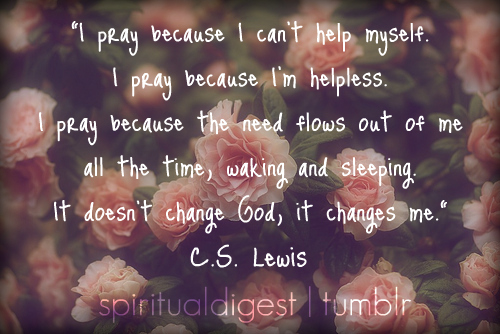
March first was my ten year anniversary of being at the Home For Needy Children in Oaxaca, Mexico. Looking back on those ten years I think about Beauty, Goodness and Truth. I have been rereading a Christian philosophy book about Beauty, Goodness and Truth, with regards to the writings of C.S. Lewis. Beauty, Goodness and Truth are three important characteristics that describe God and his work with humanity. We are created in God’s image, thus three important aspects of of humans, especially Christian humans should be Beauty, Goodness and Truth.
In God we see he created beauty in the six days of creation. Not only was it beautiful, but God pronounced it good. We also see the goodness of God in the way he provides for our physical, emotional, mental and spiritual needs. As Pastor Aaron is fond of saying, “God is good all the time” and “All the time God is good.” When it comes to truth, well, God is truth, and all truth is God’s truth. Jesus said, “I am the truth.”
As Christians we strive to be like our maker (who after creating man and woman proclaimed this special act of creation as Very Good). Everyday, followers of Christ should desire to make beauty, or make the world and the kingdom of God, more beautiful. A true disciple should also do good and acquire and disseminate truth. As I look back on my ten years in Mexico I ask myself if I have done these three things.
God loves us and wants us to be happy. He has created us to be most happy when we do these three things. I have been extremely happy these past ten years cooperating with God in making beauty, doing good and acquiring and disseminating truth. I am most happy when I am making gardens, following in the footsteps of God who made the first garden. Genesis tells us the first garden was first of all beautiful, and then good for producing fruit. I try to make gardens that are also beautiful and good for producing peace and happiness, as well as good food. I appreciate it when visitors to the Oaxaca mission tell how beautiful and peaceful it is. My primary hope is that the gardens bring a sense of peace and joy to the hurting children that we care for. We have one troubled boy who, despite his inner struggles and conflicts, consistently tells me, when I am putting in a new garden, that it is beautiful. Thank you Danny.
All the staff members at the mission do good things and practice kindness everyday. We take kids to school and pick them up. We do dishes and sweep and mop floors. We go to Oaxaca city after our “workday” is done on Tuesday evenings and spend a few more hours at the fruit and vegetable market asking vendors for donations of produce, arrive back late and unload the pickup. Usually some kids from the mission go along and help. It all makes for a long day, but I think that as we finally climb into bed, we give thanks to God that he has allowed us to participate with him in the kingdom work of helping “the least of these”. For members of the Family of God, doing good is is important, especially considering Jesus words in Matthew chapter 25 – when you feed the hungry, give drink to the thirsty, clothe the naked, take in strangers, help the sick and visit those in prison, we do it as though it were for Jesus. “When you did it to these my brothers, you have done it for me.” These ten years in Mexico I have done a few good things, by the grace of God who has allowed me to partner with brothers and sisters who share a faith to “love one another as I have loved you”.
One of my favorite things to do throughout my life has been to acquire and disseminate truth. I have always loved to read and learn and to share with others what I have learned. At the Home for Needy Children there is a primary school which offers the students a variety of electives. I have been privileged to share truth with the children on gardening, baseball and currently basketball.
There is a prison across the street and for over five years I have walked across the highway to that prison and have taught an English class to groups of women, men, and inmates in the psyche ward. Disseminating truth not only about nouns, verbs and vowels, but also about God’s love, compassion and mercy. Psalms says that God gives us the desires of our heart. God gave me the desire to learn and teach, to acquire and disseminate truth, and I am blessed that I have been able to do that in a variety of ways at the Mission in Oaxaca, Mexico.
Speaking of Beauty, Goodness and Truth that I have experienced during my time in Mexico, I am most grateful for my beautiful wife Anita, and two wonderful daughters, Sally and Kelly, that God has given me during my time here. They are so good and bring much happiness to my life. Surely God is good all the time.
I also thank God for the chance to get to know Charla Pereau , the founder of Foundation for His Ministry which operates the Home for Needy Children here in Oaxaca. She is the epitome of making beauty, doing good and sharing truth. Thousands of the “least of these” in Mexico enjoy happier lives because of her life. I am one of those.
***** ***** ***** *****
How shall I make a return to the LORD for all the good He has given me? I will take up the cup of salvation and call upon the name of the LORD. Psalm 116:12,13
There are three things that will never die: truth, goodness and beauty. These are the three things we all need, and need absolutely, and know we need, and know we need absolutely. Our minds want not only some truth and some falsehood, but all truth, without limit. Our wills want not only some good and some evil, but all good, without limit. Our desires, imaginations, feeling or hearts want not just some beauty and some ugliness, but all beauty, without limit. These three things are three attributes of God, and therefore of all of God’s creation: three transcendental or absolutely universal properties of all reality. C.S. Lewis as Philosopher: Truth, Goodness and Beauty by David J. Baggett
A few days ago in our morning devotions at the home for needy children where my wife and I serve, a lady named Mireya talked about the recent death of her mother. Her mother had been battling diabetes for many years. Not a pleasant struggle to have to endure. And then, to make matters worse, she was involved in a terrible auto accident that broke bones, inflicted bruises; internal and external, and left her in a coma for some days. She finally came out of the coma, which was a great relief for her family, but never really recovered, and ended up dying a couple weeks ago.
Mireya talked of her mother’s walk with God and the tremendous impact her faith had on her family, friends, and even the hospital staff who cried at her passing.
At about the same time of Mireya’s mother’s accident, another tragic auto collision occurred. This time to a lady named Leticia who had faithfully served at the mission in previous years with her husband Edgar. She was hit by a big truck driven by a drunk man. In the car with her were her two daughters, son, and sister in law. They all suffered a variety of bone fractures, contusions and bruises. The worst off was the sister in law who had both of her legs broken.
My wife, Anita, and I, went to visit Leticia recently, and she recounted for us the injuries and physical pain they all went through. Almost as bad as the physical pain, was, and is, is the psychological ordeal they are going through. The drunk man who crashed into Leticia was questioned by police and released. The police never filed a report and there is no evidence that they were ever on the scene. Leticia’s son took a picture of the drunk man and his license plate, which allowed them to find out where he lived. Evidently this man is a man of some means, as it seems he paid the police off and has hired a number of lawyers to defend him in case any one tries to make him pay. Edgar went to find the man in order to talk to him about the situation. He was no where to be found, and so Edgar talked to a few neighbors, telling them what happened and why he wanted to speak with the guy. He gave them his cell phone number. That evening he received a call from a relative of the drunk driver who cursed Edgar out.
What is the import of these two stories? I always say that God loves us and wants us to be happy. These are not very happy stories. The members of these families are strong, faithful Christians involved in ministry. It would be natural to ask God the question “Why”? In fact, Mireya confessed to asking that question. God answered her question. It’s not important to know what the answer was. It is important to know that our God who loves us and wants us to happy, always answers that question. Sometimes he gives the answer in a still small voice that brings us great satisfaction. Sometimes he answers that question through circumstances that follow, or with wise council from trusted friends or family members. Sometimes he answers with the response that Jesus gave John the Baptist or to Peter, which was, “What I do now you cannot understand, but in time you will.”
The New Testament writers James and Peter wrote about going through times of suffering, and both of them said that we should rejoice and be filled with joy because God uses the hard times of pain and confusion to bring about spiritual growth and greater intimacy with the Father.
Consider it pure joy, my brothers and sisters, whenever you face trials of many kinds, because you know that the testing of your faith produces perseverance. James 1:2,3
For a little while you may have had to suffer grief in all kinds of trials. These have come so that the proven genuineness of your faith – of greater worth than gold, which perishes – may result in praise, glory and honor when Jesus Christ is revealed. 1Peter1:6,7
The Old Testament prophet Habakkuk wrote about difficult times ahead for the chosen people of God. Times of distress and want; hunger and pain. This prophet also declared “though the fig tree does not bud, and there are no grapes on the vine, though the olive crop fails and the fields produce no food, though there are no sheep in the pen or cattle in the stalls, yet I will rejoice in the LORD, I will be joyful in God my Savior (Habakuk 3:17,18).”
So whether we suffer a car crash, emotional or physical crash, financial or familial crash, we can be sure that while we go through the pain, God is with us to strengthen us and encourage us, and when we come out the other end, we can rejoice and consider it pure joy that our faith is real and God is glorified.
***** ***** ***** *****

What part of the Bible comes to mind when you think of Faith, Hope and Love? Many people think of 1Corinthians 13, the so called love chapter. I was surprised to learn the other day that this trio of virtues also occurs in nine other places in the New Testament. What other three aspects of the Christian life are grouped together so often in the New Testament? None that I can think of. They must be important to God and for us that they are found so frequently. Each one is incredibly important alone, but together they speak volumes to the life of Jesus followers. I think of the word “synergy”. A concept that tells us that the whole is more than the sum of the parts. I believe that this is true with Faith, Hope and Love.
Considering this “whole” of faith, hope and love, I have some thoughts. I think God loves us and  wants us to be happy. Because of this he has opened the eyes of our hearts (Ephesians one) and this causes us to begin to understand the depths of his love (Ephesians four) and Faith comes alive in our being (Ephesians two – no, this is not a study of Ephesians). With this Faith we begin to love God and our fellow man. This love idea is basically a new concept for us that comes from the Greek word agape, which means to give of ourselves to those in need, without merit; those who have done nothing to deserve our love, and whom we don’t expect to pay us back. This is the kind of love God shows humanity a million times a day, and is especially apparent in the sacrifice of Christ on the cross. Because of the Faith that this love fosters within us, we begin to demonstrate this kind of love toward others. Experiencing this love causes us realize that God is not only good and generous to us in this life, but that there is an afterlife which will make us far happier than we can imagine trodding this earthly soil. That is our hope.
My purpose in this post is not to give a theology of faith, hope and love, but to give you the scriptures that mention faith, hope and love, allowing you to ponder the significance of these virtues as a whole, and let God grow the truth of these attributes in your hearts and minds.
Ten New Testament Passages With Faith, Hope and Love
1Th 1:2,3 We thank God for you and always mention you in our prayers. Each time we pray, we tell God our Father about your faith and loving work and about your firm hope in our Lord Jesus Christ.
1Th 5:8 But we belong to the day. So we must stay sober and let our faith and love be like a suit of armor. Our firm hope that we will be saved is our helmet.
Rom 5:2-5 Christ has also introduced us to God’s undeserved kindness on which we place our faith. So we are happy, as we look forward to sharing in the glory of God. But that’s not all! We gladly suffer, because we know that suffering helps us to endure. And endurance builds character, which gives us a hope that will never disappoint us. All of this happens because God has given us the Holy Spirit, who fills our hearts with his love.
1Co 13:13 For now there are faith, hope, and love. But of these three, the greatest is love.
Gal 5:5,6 But the Spirit gives us hope that God will accept us because of our faith in Christ. If you are a follower of Christ Jesus, it makes no difference whether you are circumcised or not. All that matters is your faith that makes you love others.
Col 1:4,5 We have heard of your faith in Christ and of your love for all of God’s people, because what you hope for is kept safe for you in heaven. You first heard about this hope when you believed the true message, which is the good news.
Heb 6:10-12 God is always fair. He will remember how you helped his people in the past and how you are still helping them. You belong to God, and he won’t forget the love you have shown his people. We wish that each of you would always be eager to show how strong and lasting your hope really is. Then you would never be lazy. You would be following the example of those who had faith and were patient until God kept his promise to them.
Heb 10:22-24 So let’s come near God with pure hearts and a confidence that comes from having faith. Let’s keep our hearts pure, our consciences free from evil, and our bodies washed with clean water. We must hold tightly to the hope that we say is ours. After all, we can trust the one who made the agreement with us. We should keep on encouraging each other to love and to do helpful things.
1Pe 1:21,22 And when he did come, it was to lead you to have faith in God, who raised him from death and honored him in a glorious way. That’s why you have put your faith and hope in God. You obeyed the truth, and your souls were made pure. Now you sincerely love each other. But you must keep on loving with all your heart.
***** ***** ***** *****

I have a tale to tell. It’s sad but true. It’s about a boy I’ll call “Run Away Lou”. Not his real name, I need to tell you. His name has been changed to protect the guilty, which Lou definitely is, although he is is not the only culpable figure in this story of woe.
It should be a happy story, full of joy and fun. Good times and laughter. Lots of sun, sand and surf. That’s the way it all began. During Christmas break most of the kids at the home for needy children where my wife and I are on staff, have some family member that they go to stay with. But, there are always about a dozen charges that have no place to go. Spending a week at the mission without the other kids there can be a depressing experience, so the staff members that stay behind usually do something special for the “left behinds”. My compassionate wife, Anita, felt God’s love strings pulling at her heart way back in August, prompting her to begin planning a beach vacation for the ones with no place to go, including Run Away Lou. She talked to some people and found a house we could rent for five days in the seaside city of Huatulco, Mexico.
The day for departure finally came, Christmas day, as a matter of fact. We loaded the pickup with food, beach umbrellas and chairs, backpacks and blankets. Some kids climbed into the pickup cab, while others filled the van, and away we went, into the sunrise.
The first couple of days were like any beach vacation you could imagine. All the kids having the time of their lives. Splashing, swimming and even snorkeling in the warm surf. Even Run Away Lou seemed to be enjoying himself immensely. I have a photo of him playing in the water, and a video of him helping to cover my daughter Sally with sand. Both record him with a winning smile having a great time.
But something clicked in his troubled 12 year old head early Sunday morning. After awhile, no matter how good things seem to be going in his life, something seems to click, to turn pleasant thoughts into bad thoughts, and Lou gets the urge to Run Away. And unfortunately he skedaddles with other people’s money or things in his pocket.
He was discovered missing about 5am Sunday morning. Also missing was the wallet from a staff member, his wife’s hearing apparatus and glasses, and my wife’s cell phone. After a quick search, the wallet, now devoid of cash, was discovered in the pickup. Later the hearing apparatus and glasses were found behind the toilet. So, it could have been worse, but our boy, Run Away Lou was no where to be seen that day.
Roughly the same event occurred at the mission several months before. Again, something clicked in the boy. Who knows what it was. Maybe thoughts of a mother who abandoned him, or a father he never knew. Maybe something as simple as a disciplinary matter he had to endure, or a chore he never wanted to do again. Perhaps the enticing idea of a life on the lamb with a wad of cash in his pocket. Whatever it was that made him snap, he left his room in the middle of the night, made his way to the visitors center, stole into the room of a sleeping volunteer from the States, rifled through his personal belongings, found a lot of pesos, and made his way into the night. And while he seems fearless in his actions, he isn’t so bright once he makes his get away. He walked a few hundred yards down the highway to a little motel and checked himself to catch 40 winks.
Again, him and the money were noticed missing in the early morn, and the search was on. Within an hour he was spotted exiting the motel by a staff member. The staff member was also spotted by Lou, and Lou made haste to make himself disappear. He was found by a governmental social service agency a couple months later and taken to an uncle. The uncle was none to excited to receive him, since Run Away Lou had absconded with the uncle’s pesos and possessions on more than one occasion. So there he lived until the kind and merciful folks at the home for needy children decided to give him one more chance, knowing that his chances at any kind of future would be better at the mission than with an uncle who begrudgingly took him in. We truly loved him and wanted him to be happy, as difficult as he could be. After all, we are a home for NEEDY children, and Lou definitely fit that description.
Naturally he was kept on a short leash after his return. He was shown lots of love, some of it Tough Love, but he seemed to accept it all as the natural course of things. I think he knew that he had made a big mistake and was grateful for a second chance. After awhile the leash grew longer. He was given more freedom and more responsibilities and to all appearances was doing well. He often hugged our administrator who made the decision to bring him back. She’s a Chicago woman and was both appreciative of his affection and also somewhat skeptical of his intentions. I don’t know if being from Chicago has anything to do with being skeptical, but she was right to be wary. She was also in Huatulco with some friends when everything went down.
She was probably awakened from a peaceful sleep at five in the morning when she was alerted to Run Away Lou’s latest escapade. The adults left the house to try and track down our little Run Away Lou. I drove the van with Anita and another staff member. One other staff member was in the truck. We all had an idea that Lou would want to get out of Dodge as soon as possible. I don’t know why we thought that. I guess that’s just the way adults think. Any way, it gave us something to do. We went to the bus terminals and van transportation services that take people to Oaxaca city. We even went to taxis. I had a picture of him on my Kindle, and another lady had his picture on her phone. Anita showed his face to a group of taxi drivers, and incredibly, or blessedly, one driver remembered giving the kid a drive to a nearby hotel. He took us to the hotel, but no luck. The clerk at the hotel said yes, this boy did try to get a room about three in the morning, but was denied. I’m not sure why. The clerk said the boy then sat on the curb and played with a cell phone.
Well, after some more searching and reports to the local a authorities police, and even a radio station, we gave up and took the rest of the kids back to the beach, albeit with heavy hearts.
That evening we were treated to a wonderful dinner out on the town, thanks to the generosity of a couple of Canadian churches who have a special place on their collective hearts for the children of Casa Hogar Oaxaca. We went back to the house with full stomachs and concerned hearts and many of us fell into a fitful sleep, Run Away Lou still on our minds and in our prayers.
Evidently we were also on the mind of Run Away Lou. Or at least our money and our possessions. At about the same time that he had left the house the night before, he returned to the premises, to the scene of the crime. In the dead of night he opened the big metal gate at the entrance of the property and let himself in.
I thought I had heard some kind of sound outside, but dismissed any idea that Run Away Lou had come back. “This is the last place he would go” I thought to myself. I was wrong. A few minutes later he was discovered trying to make himself invisible at the end of the bed in the room next door. Evidently he had been going for the tablet of a staff member sleeping in the room. The same staff member who he had robbed the night before. He had the charger in his pocket, and had grabbed the tablet off a high shelf in the darkened room. Somehow it slipped from his fingers and banged on the floor. The staff member awoke, investigated the noise, and Lou crouching at the foot of the bed. We had him back, and now had to figure out what to do with him.
Once again the administer of the mission was called. She told us that since we had reported him to the police, that we should take him to the police station and seek their help. We didn’t want Run Away Lou to run away, so under close scrutiny we put him in the van and hauled him off to the police.
They didn’t want anything to do with him. The city of Huatulco had no facilities for juvenile delinquents. Since we were legally responsible for him, he was our problem. They suggested we return him to his uncle, or take him to the appropriate authorities in Oaxaca city. We decided on the former course of action. At 2:57 am he was put aboard a van service with two adult males from our group to keep an eye on him and taken to Oaxaca. There he was met by his very disappointed house father from the mission and delivered to his uncle.
So there it is, the tragic tale of Run Away Lou. He was guilty, once again, of stealing from those who loved him, cared for him, and wanted nothing but the best for him. He had it all. He spurned it all. He gave it all up for a mess of porridge as it were, like Esau in the Bible. He gave up making sand castles on the seaside for making mudpies in the slums as C.S. Lewis once said.
I mentioned that Lou was guilty, but that others were also culpable in his demise. How about an absent father? What about the mother who abandoned him? I have never faced what our young Run Away Lou has had to face. I can not even begin to imagine the thoughts that fill his mind, that perhaps torment his thoughts. I do know that we have dozens of children at the home for needy children who have lived through similar harsh circumstances in life and are now flourishing under the loving care and guidance of staff members at the mission. Why sharing God’s love, mercy and Grace with Lou didn’t “take”, I have no idea. We all hope and pray that someday, like the prodigal son, that Run Away Lou will “come to his senses” and that instead of always running away, that he will run into the arms of our loving heavenly Father. I hope and pray that someday Run Away Lou will become Run To The Father Lou.
So why did I title this story Putting the HAPPY in 2015? Because, in a sense, we are all Run Away Lou’ s. We are in the care of a God who loves us and wants us to be happy, just as Lou was in the midst of a community of Faith who loved him and wanted him to be happy. God has provided the perfect recipe for happiness. It’s called the Bible. We have a choice to make. We can choose to follow and obey the commands of the Bible and live in right relationship with God, or follow the inclinations of the World, the Flesh, and the Devil, and live in misery. Lou made disastrous choices and is not happy.
This New Year, let’s run into the loving arms of the Father, abide in Christ, be filled with the Holy Spirit, and experience true happiness!
***** ***** ***** *****

*****
***** ***** ***** *****
 To Enjoy God